
Zero Fee Merchant Processing: How Cash Discount Programs Eliminate Credit Card Fees
Cash discount programs eliminate credit card processing fees by posting credit card prices as standard and offering a discount for cash payments. Charge.com offers this program with zero setup fees and no long-term contracts. Businesses accept all major credit cards while customers choosing cash pay a reduced price. Merchants retain the full value of each transaction.
Key Takeaways
- Cash discount programs eliminate credit card processing fees by posting credit card prices as standard and offering a discount for cash payments.
- A cash discount program removes the credit card processing fees that businesses would otherwise incur on every transaction.
- A cash discount posts credit card prices and offers a discount for cash, while a surcharge adds a fee to card payments.
- Properly structured cash discount programs are legal in all 50 states when implemented correctly.
What is a cash discount program and how does it work?
A cash discount program lets a business accept credit cards without paying merchant service fees. The mechanism posts credit card prices as the standard, then offers a lower price to customers who pay with cash. Cardfellow distinguishes the two models clearly: a cash discount posts credit card prices and offers a discount for cash, while a surcharge posts cash prices and adds a fee to card payments. This distinction carries legal weight for compliance and customer perception.
Business owners lose a portion of every transaction to credit card processing fees, according to Shift Processing. A cash discount program eliminates that recurring cost entirely. Charge.com includes zero fee merchant processing options within its merchant services portfolio, alongside interchange-plus rates starting at 0.25% and no long-term contracts.
How does a cash discount program work step by step?
- Post credit card prices as the standard listed price for all goods and services.
- Display signage at the point of sale stating that a discount applies to cash payments.
- Apply the discount automatically at checkout when a customer pays with cash or debit.
- Process credit card transactions at the posted price without absorbing processing fees.
- Reconcile daily sales with zero merchant service fee deductions on cash transactions.
Is a cash discount the same as a surcharge?
No. A cash discount reduces the price for cash payers below the posted credit card price. A surcharge adds a fee above the posted cash price for card payers. Cardfellow notes that confusion between these models has led some providers to label surcharge programs as cash discount programs. Businesses seeking zero fee credit card processing must verify which model a provider actually implements.
Charge.com delivers no monthly fee credit card processing through cash discount programs that incorporate processing costs into posted card prices rather than presenting them as an explicit surcharge line item. The program structure keeps pricing transparent while removing the transaction cost that erodes margins.

Is zero fee merchant processing legal in all states?
Zero fee merchant processing through a properly structured cash discount program is legal in all 50 states when implemented correctly. The critical distinction lies in how the program is presented to customers. A cash discount posts credit card prices and offers a reduction for cash payments. A surcharge posts cash prices and adds a fee for card payments. This difference determines regulatory compliance across state jurisdictions.
What is the legal difference between a cash discount and a surcharge?
A cash discount program lists credit card prices as the standard posted price. Customers paying with cash receive a discount from that listed amount. This structure complies with card brand rules nationwide. A surcharge program lists cash prices and adds an additional fee when customers pay by card. Surcharging faces stricter state-level restrictions and is outright prohibited in several states. The distinction matters because mislabeling a surcharge as a cash discount creates compliance exposure that can trigger fines or forced program termination.
Which states restrict surcharging on credit card transactions?
Several states maintain laws limiting or banning credit card surcharges. These regulations apply specifically to surcharge programs, not to properly structured cash discount programs. Business owners operating in states with surcharge restrictions avoid compliance risk entirely by adopting a cash discount model instead. The cash discount approach posts the higher credit card price as the baseline, making the cash price a discount rather than imposing an additional fee on card users.
Charge.com provides dedicated US merchant underwriting to guide businesses through these compliance requirements. The company’s underwriting team evaluates each merchant’s setup to confirm the program structure aligns with both card brand regulations and applicable state laws. This oversight prevents the common pitfall of confusing cash discounts with surcharges, a confusion that CardFellow identifies as widespread in the payments industry. Proper structuring eliminates processing costs without creating regulatory liability.
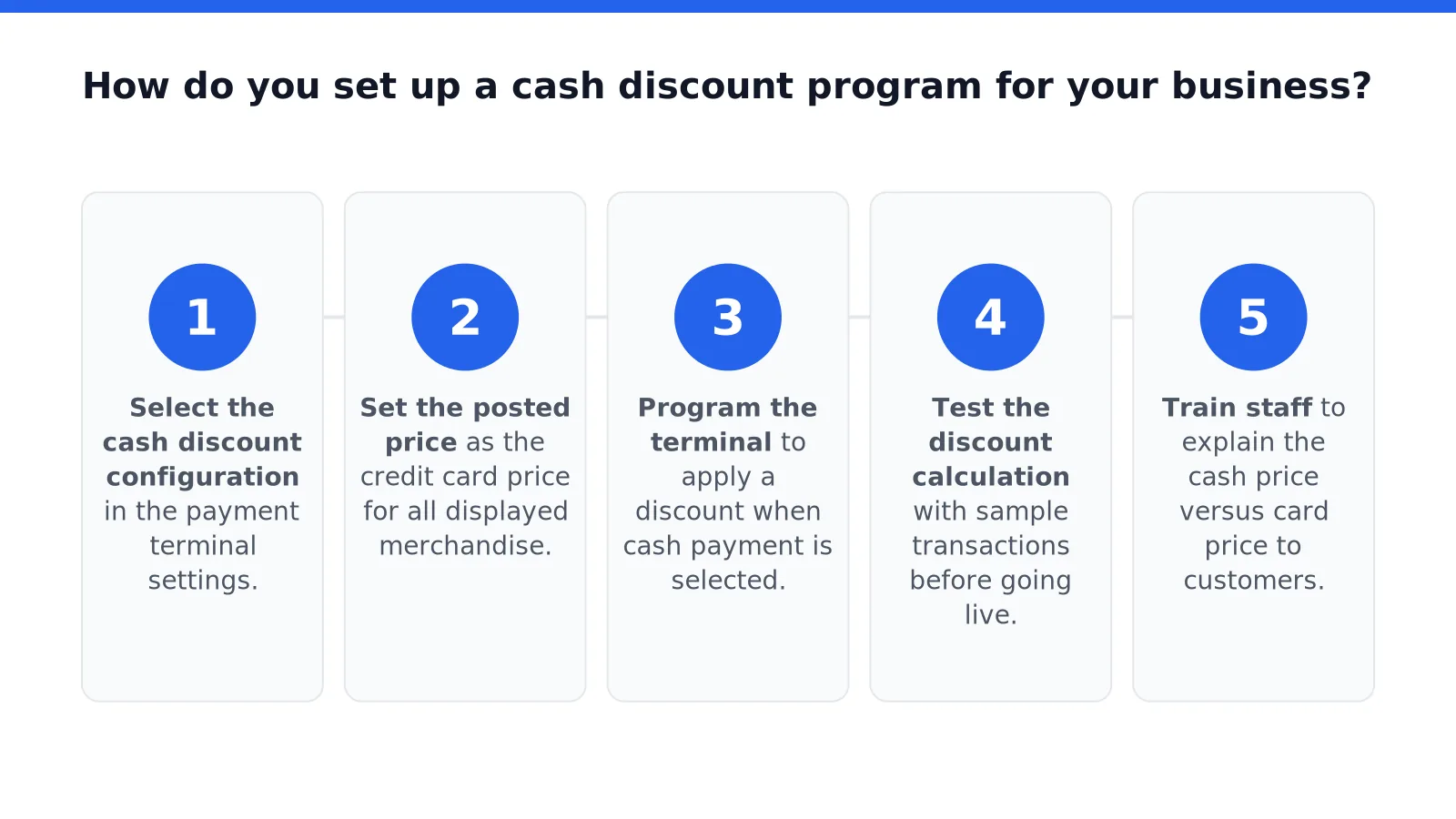
How do you set up a cash discount program for your business?
Setting up a cash discount program requires a systematic approach that incorporates processing costs into posted card prices while preserving full legal compliance. A properly configured program eliminates all credit and debit card fees that typically burden business operations. The setup process involves point-of-sale configuration, hardware deployment, and staff training.
What equipment does a cash discount program require?
Charge.com supplies free EMV countertop terminal hardware and free mobile readers for iOS and Android devices. These terminals apply the cash discount automatically at the point of sale. The hardware integrates with existing payment workflows without additional setup fees.
How do you configure the point-of-sale system?
Follow these steps to implement the program correctly:
- Select the cash discount configuration in the payment terminal settings.
- Set the posted price as the credit card price for all displayed merchandise.
- Program the terminal to apply a discount when cash payment is selected.
- Test the discount calculation with sample transactions before going live.
- Train staff to explain the cash price versus card price to customers.
The terminal applies the discount at the point of sale, incorporating the processing cost into the posted card price. This method remains fully compliant in all 50 states.
What ongoing support is available after setup?
Charge.com provides 24/7/365 US-based technical support for setup assistance and ongoing operation. Business owners receive dedicated US merchant underwriting throughout the implementation process. The zero fee merchant processing model requires no long-term contracts and carries zero cancellation fees.
What are the requirements for terminal receipts and signage?
Terminal receipts and point-of-sale signage must clearly communicate the cash discount program to every customer. A cash discount posts credit card prices and offers a lower price for cash payments. A surcharge posts cash prices and adds a fee at the register. The distinction carries legal weight. Cardfellow’s analysis of card brand regulations states that charging more at the register than the listed price constitutes a surcharge, regardless of what processors call it. Businesses that mislabel surcharges as discounts risk non-compliance penalties and customer disputes.
What signage is required at the point of sale?
Proper signage eliminates ambiguity. Posted prices must reflect credit card rates, with the cash discount clearly advertised as a reduction from that listed price. The signage informs customers before they reach the register. Without visible disclosure, the transaction structure collapses into surcharging territory. Charge.com’s zero fee merchant processing solutions include guidance on compliant signage placement and wording.
How must terminal receipts display the cash discount?
Receipts reinforce the pricing structure established by signage. Each receipt shows the posted credit card price, the cash discount applied, and the final amount paid. Charge.com’s free EMV countertop terminals and free virtual terminals support compliant receipt formatting. These tools print or display the discount terms automatically, reducing manual errors at checkout.
What hardware supports compliant receipt printing?
Charge.com provides free EMV countertop terminal hardware and free mobile readers for iOS and Android. These devices maintain PCI-DSS payment compliance throughout every transaction. The terminals print receipts that itemize the cash discount separately from the base price. This separation creates an audit trail that satisfies card brand rules. Businesses using zero fee credit card processing through Charge.com’s cash discount program receive hardware configured for compliance from the first transaction.
How much can you save with zero processing fee credit card processing?
Savings depend directly on monthly processing volume and current fee structure. A zero processing fee credit card model eliminates the recurring cost of card acceptance entirely.
Businesses lose a portion of every credit card transaction under traditional pricing. Those percentages compound quickly across monthly volume. A cash discount program offsets those fees by shifting processing costs away from the merchant.
How do businesses calculate potential savings?
- Determine total monthly credit card processing volume.
- Enter that dollar amount into a savings calculation tool.
- Review the projected annual savings figure.
Cash Discount Program’s savings tool lets merchants slide a dollar amount to enter monthly volume and see projected savings immediately.
What does a no-fee model actually eliminate?
A zero fee merchant processing approach removes the costs tied to conventional card acceptance programs. Paystri notes that adopting a no-fee payment processing model saves businesses the costs associated with traditional card acceptance.
Charge.com offers interchange-plus domestic rates starting at 0.25%, with zero setup fees and zero cancellation fees. Those terms maximize net profit margins for retail, mobile, B2B, and e-commerce operations.
Is zero monthly fee processing realistic?
No monthly fee credit card processing removes fixed overhead from payment acceptance. Merchants keep more profit per transaction. The savings accumulate without long-term contracts or cancellation penalties.
FAQ
How does a cash discount program eliminate credit card processing fees?
A cash discount program posts credit card prices as the standard and offers a lower price to cash payers. Charge.com applies the discount automatically at checkout, so merchants retain the full transaction amount without absorbing processing costs.
Is a cash discount program the same as a surcharge?
No. A cash discount posts credit card prices and offers a discount for cash, while a surcharge posts cash prices and adds a fee to card payments. Charge.com implements the cash discount model to eliminate processing costs without adding a separate line item.
Is zero fee merchant processing legal in all 50 states?
Yes, when implemented correctly as a cash discount program. The program must post credit card prices as standard and offer a discount for cash, which keeps it compliant across all state jurisdictions.
Conclusion
A cash discount program eliminates credit card processing fees by incorporating the cost into posted card prices through a compliant pricing structure. Business owners who implement this model with proper signage, terminal configuration, and staff training remove processing costs from their operations entirely. The next step involves evaluating current monthly volume and contacting a provider to begin setup.