
Credit Repair Merchant Accounts: Reliable High-Risk Payment Processing
Credit repair merchant accounts require specialized high-risk payment processing from providers experienced in the category. Charge.com delivers dedicated underwriting, recurring-billing tooling, and human support for licensed credit repair operators. The company supports businesses across diverse industries, including high-risk verticals, with domestic interchange-plus rates starting at 0.25% and no long-term contracts.
Key Takeaways
- Credit repair businesses require specialized high-risk merchant accounts because standard processors routinely decline them.
- Charge.com provides dedicated underwriting, recurring-billing tooling, and human support for licensed credit repair operators.
- Underwriters evaluate business licenses, processing history, service scope, client agreements, and bank statements for approval.
- Specialized credit repair merchant accounts eliminate the freeze and shutdown risks common with aggregator platforms like PayPal and Stripe.
What is a credit repair merchant account?
A credit repair merchant account is a specialized payment processing agreement enabling credit repair businesses to accept credit and debit card transactions. Standard processors routinely decline these companies. The account functions as a dedicated underwriting pathway for an industry classified as high risk.
Why do standard processors reject credit repair businesses?
PayPal, Stripe, Zelle, Cash App, and Square actively prohibit and suspend credit repair businesses. Using these platforms risks account shutdown and compliance complications. Most conventional merchant accounts follow the same restrictive pattern. Banks and credit card processors consider credit repair services high risk and remain unwilling to provide standard merchant services.
What makes the industry high risk?
The credit repair sector generates over $3 billion in annual revenue, with more than 80,000 businesses delivering services to consumers, according to Soar Payments. These companies help clients correct poor credit standing through dispute filings and credit agency challenges. Elevated chargeback ratios and regulatory scrutiny drive the high-risk classification. Specialized underwriting addresses these factors directly.
Charge.com delivers domestic US merchant credit card processing with PCI-DSS payment compliance, enabling credit repair operators to accept payments securely. A dedicated merchant account for credit repair provides stable processing without the freeze risk common to aggregator platforms. Credit repair merchant processing through a purpose-built provider sustains reliable revenue flow. Businesses seeking high risk merchant processing for credit repair gain access to underwriting teams familiar with the industry’s compliance requirements and transaction patterns.
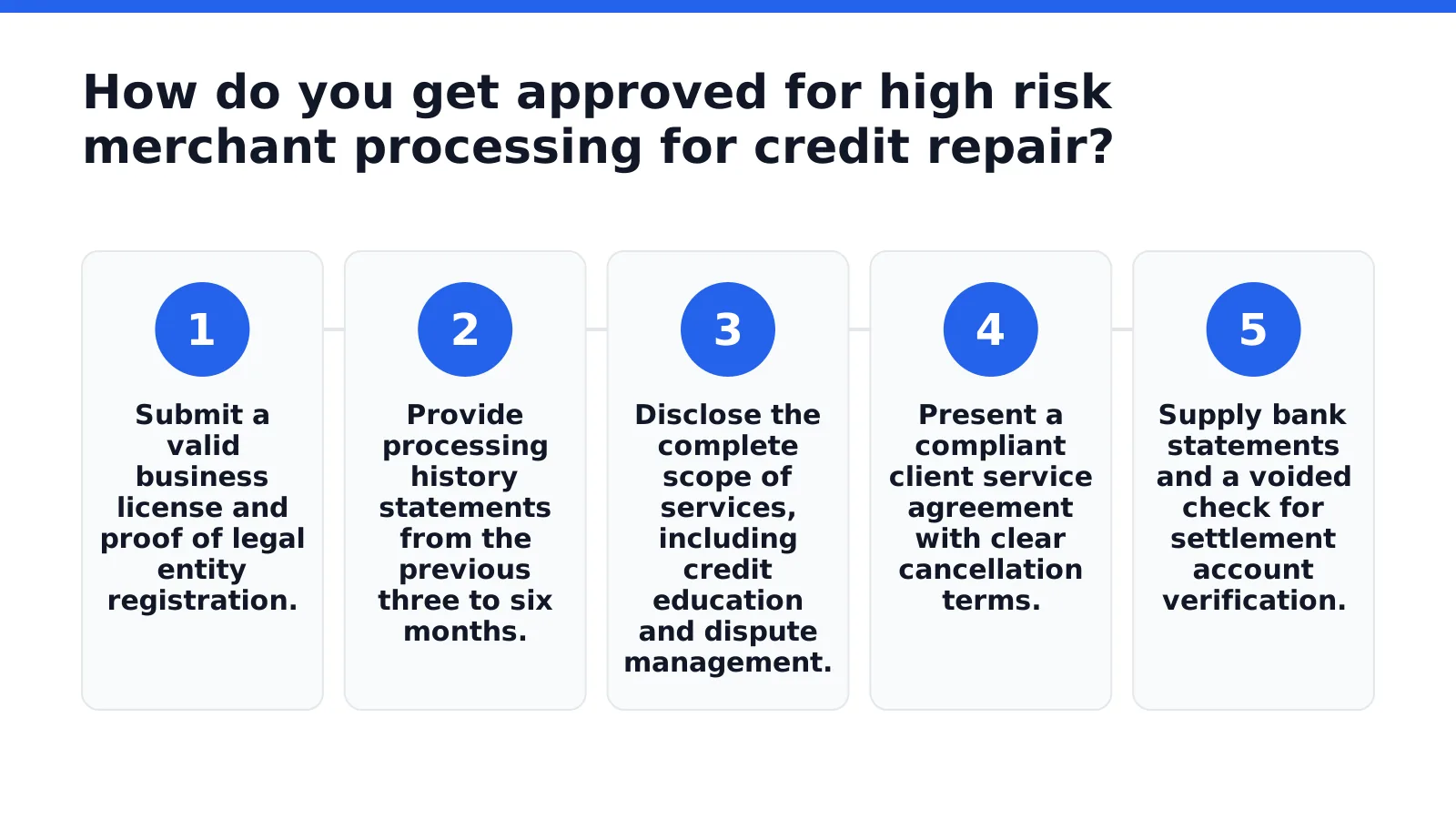
How do you get approved for high risk merchant processing for credit repair?
Approval for high risk merchant processing for credit repair requires a dedicated underwriting process. A specialized credit repair merchant account provides real underwriting, recurring-billing tooling, and a dedicated representative assigned to the file. Standard processors routinely decline credit repair businesses. Without a properly underwritten account, operators face sudden holds, frozen funds, and terminated processing relationships that disrupt revenue and client trust.
What documentation do processors require for a credit repair merchant account?
Underwriters evaluate several specific items before approving a merchant account for credit repair. The process demands transparency and verifiable business practices.
- Submit a valid business license and proof of legal entity registration.
- Provide processing history statements from the previous three to six months.
- Disclose the complete scope of services, including credit education and dispute management.
- Present a compliant client service agreement with clear cancellation terms.
- Supply bank statements and a voided check for settlement account verification.
Charge.com delivers dedicated US merchant underwriting for these applications. The company provides free EMV countertop terminal hardware, free mobile readers for iOS and Android, and free virtual terminals to support operations immediately upon approval.
Which credit repair business models qualify for specialized processing?
Underwriters approve a range of compliant business models. Qualifying operations include credit repair services, credit monitoring, credit consulting, credit education, dispute services, and identity restoration. Each model undergoes the same rigorous review.
Pricing structures directly impact long-term processing costs. Charge.com features interchange-plus domestic low rates starting at 0.25%, with zero setup fees, zero cancellation fees, and no long-term contracts. Operators seeking guidance on initial setup can review the process for getting a merchant account for a small start-up business. A complete application package with accurate documentation accelerates the underwriting timeline and reduces the risk of unnecessary delays.

What steps ensure compliance and reduce chargebacks?
Compliance and chargeback reduction begin with a specialized credit repair merchant account. Standard processors actively prohibit credit repair businesses. Using them risks shutdown and potential compliance issues. A dedicated merchant account for credit repair eliminates this existential threat.
What billing models trigger the fewest disputes?
Transparent billing structures reduce client confusion and subsequent chargebacks. Providers supporting credit repair merchant processing accommodate diverse models without flagging transactions as suspicious. These models include:
- Monthly recurring billing
- Pay-per-deletion models
- Hybrid billing
- Upfront fee handling
- ACH acceptance
Each model carries distinct compliance requirements. The processor must understand the regulatory framework governing these structures. Misaligned billing triggers unnecessary disputes that damage standing with acquiring banks.
How does ongoing support prevent compliance failures?
Continuous access to technical expertise proves essential for high risk merchant processing for credit repair. Charge.com provides 24/7/365 US-based technical support to assist with ongoing compliance and operational issues. This constant availability means anomalies receive immediate attention before escalating into formal disputes. Processors unfamiliar with credit repair often freeze accounts without warning. Those freezes cripple cash flow and sever client relationships. A specialized provider ensures businesses process payments safely without the fear of sudden account freezes or shutdowns. For operations facing elevated risk profiles, high-risk ACH processing demands equally specialized underwriting and monitoring protocols.
FAQ
Why do standard processors reject credit repair businesses?
PayPal, Stripe, Zelle, Cash App, and Square actively prohibit and suspend credit repair businesses, and most conventional merchant accounts follow the same restrictive pattern.
### How does Charge.com support credit repair businesses?
Charge.com delivers dedicated underwriting, recurring-billing tooling, human support, and domestic interchange-plus rates starting at 0.25% with no long-term contracts.
Conclusion
Selecting a specialized credit repair merchant account eliminates the existential risk of sudden account freezes and revenue disruption. Operators who partner with a provider experienced in high-risk underwriting secure stable payment processing, compliant billing structures, and continuous technical support. This decision directly protects cash flow and client trust, enabling the business to focus on core service delivery without processing interruptions.