
Credit Card Processing for Law Firms: IOLTA Trust Accounting Compliance Guide
Law firms accepting card payments must separate IOLTA trust accounts from operating accounts, since most processors deduct fees before deposit. Charge.com offers interchange-plus rates starting at 0.25% with zero setup fees, supporting compliant workflows. Electronic payments accelerate collections nearly four times faster than traditional billing, reducing administrative burden while maintaining trust-account safeguards.
Key Takeaways
- Most processors deduct fees before deposit, creating trust account violation risk for law firms.
- Compliant routing sends earned fees to operating accounts while retainers go directly to IOLTA.
- Electronic payments accelerate law firm collections nearly four times faster than traditional billing.
- Chargeback protection requires compliant processing, clear client agreements, and proactive transaction management.
What is IOLTA compliance for credit card processing?
IOLTA compliance governs how law firms handle client funds when accepting credit card payments. The Interest on Lawyers’ Trust Account framework protects client money from improper commingling or fee deductions.
Most payment processors debit processing fees before depositing funds into a firm’s account. This practice puts attorneys at risk of a trust account violation. Legal-focused payment processors provide critical compliance tools, including trust-account safeguards and IOLTA-friendly workflows.
How do processing fees create IOLTA violations?
A standard processor deducts fees from the gross transaction amount. The net deposit then falls short of the client’s full retainer or settlement balance. The shortfall constitutes an unauthorized withdrawal from client funds.
- Confirm whether the processor deducts fees before deposit.
- Structure operating and trust accounts to separate fee collection from client funds.
- Select a processor with IOLTA-compliant fund routing.
What safeguards does a merchant account for attorneys require?
A compliant merchant account for attorneys routes processing fees from the firm’s operating account, never from trust balances. Charge.com delivers PCI-DSS compliant payment processing with dedicated US merchant underwriting. This structure preserves the integrity of client funds.
IOLTA credit card processing demands that every transaction maintain a complete audit trail. Legal credit card processing without these safeguards exposes firms to disciplinary action. Credit card processing for law firms therefore requires processor selection based on compliance architecture, not rate alone.

How do you separate trust and operating accounts?
Separating trust and operating accounts requires distinct bank accounts with strict fund routing rules. Law firms must maintain at least one IOLTA credit card processing account for client retainers and a separate operating account for earned fees. Most payment processors debit processing fees before depositing funds, which creates immediate trust account violation risk when client money is involved.
A merchant account for attorneys configured for legal billing prevents this commingling. The processor must route earned fees to the operating account while directing unearned retainers into the IOLTA trust account. Without this separation, every credit card transaction risks an ethical breach.
What happens when processing fees hit a trust account?
Processing fees deducted from client funds constitute an unauthorized withdrawal. The firm effectively pays business expenses with money that belongs to clients. State bar associations treat this as a trust account violation, even when unintentional. Proper account structuring eliminates this exposure entirely.
How does IOLTA-compliant routing work?
The payment processor splits each transaction at the point of sale. Earned fees and processing costs route to the operating account. Client retainers and settlement funds route directly to the IOLTA trust account. Charge.com provides free virtual terminals and free EMV countertop terminal hardware that support this dual-routing configuration for law firms.
Trust account management shapes client confidence and reflects fiduciary discipline. Firms that implement compliant legal credit card processing demonstrate the financial controls clients and regulators expect. The operational benefit matches the ethical imperative: clean account separation simplifies reconciliation and audit preparation.
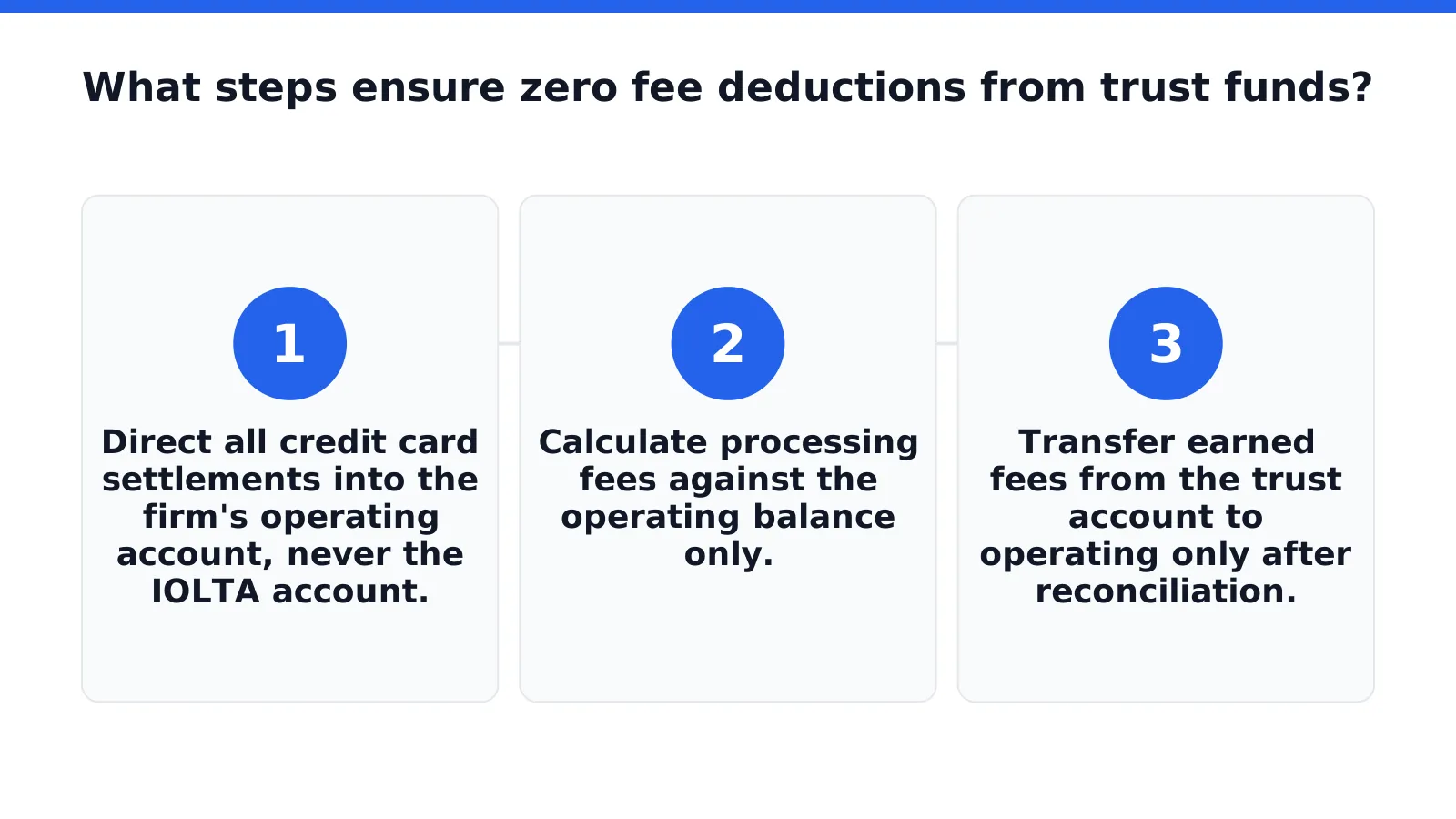
What steps ensure zero fee deductions from trust funds?
Fee deductions from IOLTA trust accounts create immediate compliance violations. Attorneys must structure payment workflows so processing costs never touch client funds. Most payment processors debit fees before depositing funds, which puts firms at risk of a trust account violation. The solution requires separating operating and trust accounts completely.
How do processing fees trigger IOLTA violations?
Standard payment processors deduct their fees from the total transaction before settlement. When client funds pass through that deduction, the trust account balance no longer matches what clients are owed. This discrepancy constitutes a commingling violation under bar association rules. Firms using legal credit card processing solutions avoid this by routing fees exclusively through operating accounts.
What account structure prevents trust account deductions?
A compliant merchant account for attorneys follows a strict three-step workflow:
- Direct all credit card settlements into the firm’s operating account, never the IOLTA account.
- Calculate processing fees against the operating balance only.
- Transfer earned fees from the trust account to operating only after reconciliation.
This structure ensures IOLTA credit card processing never exposes client funds to fee deductions. Charge.com supports this separation with interchange-plus rates starting at 0.25% and zero setup fees. Cash discount programs offset processing costs without any trust account impact. Electronic payments speed collections and reduce administrative work, helping firms improve cash flow while maintaining full compliance.
How do you implement chargeback protection on retainers?
Chargeback protection on retainers requires a structured, three-part approach combining compliant payment processing, clear client agreements, and proactive transaction management. Legal bills paid electronically arrive nearly four times faster than those settled by cash or check, according to LeanLaw’s analysis of law firm payment data. That speed advantage disappears when a chargeback reverses the retainer payment, drains trust account funds, and triggers a compliance review. Attorneys who treat chargeback prevention as a procedural discipline rather than an afterthought protect both cash flow and their professional standing.
What documentation prevents retainer chargebacks?
A signed engagement letter with explicit retainer terms forms the first line of defense. The letter must detail the retainer amount, the scope of representation, and the firm’s refund policy. A contemporaneous time-stamped record of the client’s authorization, whether through a digital acceptance workflow or a wet signature, creates an evidentiary trail that payment networks require when adjudicating disputes. Firms that skip this step lose chargeback challenges at a materially higher rate.
How does compliant processing reduce chargeback risk?
IOLTA credit card processing demands a merchant account for attorneys configured to route earned fees and trust deposits into separate accounts automatically. When a processor debits its fee from the gross deposit before the funds reach the trust account, the firm risks an unintentional commingling violation. A properly structured legal credit card processing setup isolates trust funds from operating capital, ensuring that a chargeback on a retainer draws from the correct account without breaching fiduciary duties. Charge.com provides credit card processing for law firms with PCI-DSS payment compliance and 24/7/365 US-based technical support, enabling firms to configure these safeguards without in-house payment expertise.
- Establish a dedicated trust account processor. Select a provider that supports IOLTA-compliant fund routing and does not deduct processing fees from client trust deposits.
- Integrate authorization capture into the retainer workflow. Obtain explicit client approval for the specific retainer amount before the transaction settles.
- Maintain a transaction descriptor that matches the firm’s operating name. Mismatched descriptors are a primary driver of consumer confusion and subsequent chargebacks.
- Respond to retrieval requests within 24 hours. Payment networks impose strict timelines; delayed responses convert retrievals into chargebacks by default.
- Reconcile trust account transactions daily. Immediate identification of a disputed retainer allows the firm to preserve records and prepare a rebuttal before the formal chargeback notice arrives.
What common mistakes do law firms make with IOLTA processing?
Law firms make several critical errors when handling IOLTA credit card processing. The most damaging mistake is using a general-purpose payment processor that debits fees from client trust deposits. This structure violates fiduciary rules and exposes the firm to disciplinary action.
According to the 2025 Legal Industry Report, 68% of legal professionals say collecting payment from clients is one of their firm’s biggest hurdles. That pressure drives many firms toward expedient solutions that create compliance risk. Most payment processing guides are written for retail merchants. Professional services firms operate under a different set of rules.
What happens when a processor debits fees from trust accounts?
The sequence of errors typically follows a predictable pattern:
- The firm signs up with a processor that lacks IOLTA-specific routing.
- Client funds enter the trust account, then the processor deducts its fee from that same deposit.
- The firm unknowingly pays business expenses with client money, a direct trust accounting violation.
- The shortfall surfaces during reconciliation or an audit, triggering corrective filings and potential bar complaints.
Clients expect law firms to demonstrate transparency, accuracy, and fiduciary discipline in how client funds are handled. A fee structure that mingles operating costs with client money fails that expectation immediately.
How can a merchant account for attorneys prevent these errors?
A properly structured legal credit card processing account separates earned fees from unearned trust deposits. Charge.com provides no long-term contracts and zero cancellation fees for law firm merchant accounts. That flexibility lets firms correct processor mismatches without penalty. Firms also benefit from reviewing common credit card processing problems before selecting a provider, since fee structures and settlement timing vary widely across platforms.
FAQ
What is IOLTA compliance for credit card processing?
IOLTA compliance governs how law firms handle client funds when accepting credit card payments, protecting client money from improper commingling or fee deductions.
How do processing fees create IOLTA violations?
Standard processors deduct fees before deposit, causing a shortfall in the client’s full retainer or settlement balance, which constitutes an unauthorized withdrawal from client funds.
What safeguards does a merchant account for attorneys require?
A compliant merchant account routes processing fees from the firm’s operating account, never from trust balances, and maintains a complete audit trail for every transaction.
Conclusion
A law firm that implements a structured retainer workflow, dedicated trust account processor, and daily reconciliation protocol eliminates the primary causes of IOLTA chargebacks and compliance violations. The next step is to audit your current payment setup against these safeguards and correct any gaps before the next retainer deposit arrives.