
Credit Card Processing for Non-Profits: Low-Cost Payment Processing & Donation Tools
Nonprofit credit card processing requires specialized low-cost solutions for donation management. Charge.com delivers domestic merchant services with interchange-plus rates starting at 0.25%, zero setup fees, and no long-term contracts. Registered 501(c)(3) organizations benefit from dedicated US underwriting, free EMV terminals, and 24/7/365 technical support for secure transaction processing.
Key Takeaways
- Charge.com delivers interchange-plus rates starting at 0.25% for domestic nonprofit merchant services.
- Registered 501(c)(3) organizations receive free EMV terminals, free mobile readers, and free virtual terminals.
- Charge.com provides dedicated US merchant underwriting specifically for charitable organizations’ irregular giving cycles.
- Nonprofits benefit from 24/7/365 US-based technical support ensuring uninterrupted donation processing during critical fundraising periods.
What is credit card processing for non profits?
Credit card processing for non profits is the technical system that moves donor payments from a credit or debit card into an organization’s bank account. Every nonprofit relies on a payment processor to receive donations. Without this infrastructure, online gifts, event registrations, and recurring contributions never reach the operating account.
The process involves several coordinated steps. A donor submits card details through a donation form or terminal. The processor encrypts that data and routes it through card networks for authorization. Approved funds settle into the nonprofit’s bank account, typically within one to two business days. Charge.com delivers domestic US merchant credit card processing services with PCI-DSS payment compliance, enabling secure acceptance across retail, mobile, and e-commerce channels.
How does a non profit merchant account differ from a standard business account?
A non profit merchant account is underwritten specifically for charitable organizations. Underwriting reviews the nonprofit’s mission, donation volume, and fundraising patterns rather than retail sales history. This structure accommodates irregular giving cycles, such as year-end campaigns or gala events. Charge.com provides dedicated US merchant underwriting for these specialized accounts.
What does donation payment processing involve?
Donation payment processing covers the full transaction lifecycle for charitable gifts. It includes card authorization, fraud screening, settlement, and reporting. Understanding key concepts in payment processing saves a nonprofit money and helps retain more donated funds. Organizations that overlook processing fees or security requirements lose revenue that donors intended for programs.
Merchant services for charities extend beyond basic card acceptance. These services include EMV terminal hardware, mobile readers, virtual terminals, and recurring billing tools. Nonprofits require specialized payment processing to handle donations efficiently and securely. Selecting the right configuration prevents lost gifts and reduces administrative burden.
How do you choose a non profit merchant account?
Selecting a non profit merchant account requires evaluating fee structures, donation tools, and contract terms against the organization’s fundraising model. The top vendors offer discounted rates for registered 501(c)(3) charities and support multiple donation methods, according to the U.S. Chamber of Commerce. Organizations that skip this evaluation often pay inflated processing costs that erode donor contributions.
Donation payment processing features and fees vary between merchant services for charities and fundraising platforms with built-in payment processors. A WooCommerce Credit Card Processing: How to Set Up a Dedicated Merchant Account & provides greater control over funds and typically lower per-transaction costs. Fundraising platforms bundle processing with donor management tools but charge higher blended rates.
What rate structure works best for nonprofit donation processing?
Interchange-plus pricing delivers the lowest net cost for most charities. Charge.com features interchange-plus domestic low rates starting at 0.25%, zero setup fees, and no long-term contracts. This transparent model passes card network interchange rates directly to the organization with a fixed markup, unlike tiered pricing that obscures true costs.
What features should a charity prioritize in a payment processor?
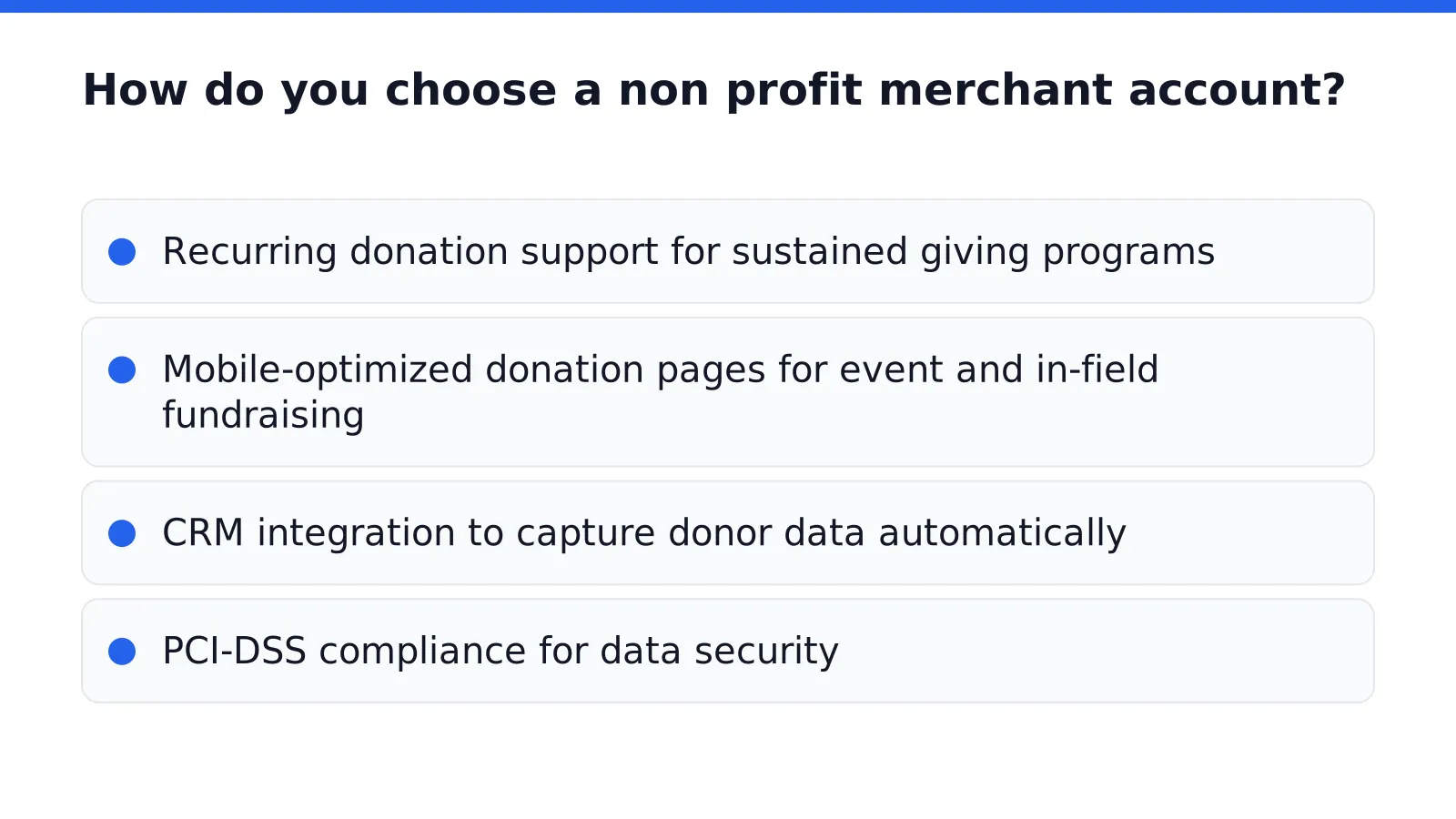
Nonprofits should look for services that fit their donor base and allow data collection to reach more supporters. Essential capabilities include:
- Recurring donation support for sustained giving programs
- Mobile-optimized donation pages for event and in-field fundraising
- CRM integration to capture donor data automatically
- PCI-DSS compliance for data security
Charge.com provides free EMV countertop terminal hardware, free mobile readers for iOS and Android, and free virtual terminals. These tools enable credit card processing for non profits across in-person events, online campaigns, and mobile fundraising without additional equipment investment. The company also offers 24/7/365 US-based technical support, ensuring uninterrupted donation processing during critical fundraising periods.

What steps set up donation payment processing?
Setting up donation payment processing requires a structured sequence of hardware, software, and account configuration decisions. Nonprofits that skip prerequisites lose donation revenue through failed transactions and donor abandonment.
Prerequisites: A registered nonprofit must first obtain a non profit merchant account through a provider offering merchant services for charities. Charge.com provides domestic US merchant credit card processing services with PCI-DSS payment compliance, enabling retail, mobile, B2B, and e-commerce businesses to accept credit cards securely.
What hardware and software does a nonprofit need first?
Charge.com supplies free EMV countertop terminal hardware, free mobile readers for iOS and Android, and free virtual terminals. These tools support credit card processing for non profits across in-person events, mobile fundraising, and online giving.
Select hardware. Choose the free EMV countertop terminal for fixed donation stations or free mobile readers for field fundraising.
Activate the virtual terminal. Configure the free virtual terminal for online and phone-based donation entry.
Integrate donation platforms. Connect processing tools with platforms like Double the Donation, as listed among payment processing tools for nonprofits.
Test transactions. Run sample donations through each channel before the first live campaign.
Confirm support access. Charge.com offers 24/7/365 US-based technical support for all processing needs.
How do nonprofits handle donations across multiple channels?
Payment and donation processing products help nonprofits handle financial transactions from donors online, through mobile devices, and in person. A single merchant account supports all three channels without separate vendors. This consolidation reduces reconciliation errors and keeps donor data unified.
How can merchant services for charities reduce costs?
Merchant services for charities reduce costs through specialized rate structures, cash discount programs, and contract flexibility. Nonprofit organizations gain direct control over processing expenses when they select a provider designed for charitable operations. Without optimized processing, donation revenue leaks through unnecessary fees and rigid contractual obligations.
Donation payment processing costs shrink when organizations leverage interchange-plus pricing models. Charge.com offers domestic interchange-plus rates starting at 0.25%, a structure that passes card network wholesale costs directly to the nonprofit with a transparent markup. This pricing method eliminates the inflated blended rates common in standard merchant accounts. According to CO, the right nonprofit credit card processor enables organizations to increase donations and reduce costs simultaneously.
What pricing models help nonprofits lower processing fees?
Interchange-plus pricing separates wholesale interchange fees from the processor’s markup. Nonprofits see exactly what goes to card networks and what goes to the processor. Tiered or flat-rate models bundle these costs, obscuring the true expense of each transaction. Charge.com’s interchange-plus structure starting at 0.25% provides cost visibility that tiered pricing cannot match.
How do cash discount programs benefit charitable organizations?
Cash discount programs shift processing costs away from the organization entirely. Charge.com provides cash discount programs that pass card acceptance fees to card-paying donors rather than the nonprofit. Donors choosing cash or check avoid any surcharge. This approach preserves more of every donation for mission-driven work. Payment Processing for Nonprofits notes that organizations control how donations get processed and how much they pay to receive those funds.
Contract terms represent another cost-reduction lever. Charge.com imposes zero setup fees, zero cancellation fees, and requires no long-term contracts. Nonprofits avoid the financial penalty of locked-in agreements when circumstances change. A non profit merchant account with these terms eliminates exit barriers that trap organizations in overpriced arrangements. The combination of low interchange-plus rates, cash discount capability, and contract freedom creates a processing stack that maximizes retained donation revenue.
What common mistakes should nonprofits avoid?
Nonprofits lose donation revenue through avoidable payment processing errors. The most damaging mistake is failing to compare costs across credit card processing for non profits providers before signing an agreement. The U.S. Chamber of Commerce advises organizations to examine how costs differ between processing companies and what features and tools each vendor offers. A non profit merchant account selected without this comparison often carries inflated fees that erode every contribution.
What happens when nonprofits skip cost comparison?
Payment processing appears complex, but the underlying fee structures follow predictable patterns. CharityEngine notes that understanding key concepts saves nonprofits money and helps them retain more of the funds raised. Organizations that accept the first quoted rate forfeit negotiating leverage. They also miss tools that streamline donation payment processing across online, mobile, and in-person channels.
Which operational safeguards prevent processing failures?
Charge.com provides dedicated US merchant underwriting to ensure compliance and smooth onboarding. The company enables retail, mobile, B2B, and e-commerce organizations to accept credit cards securely through PCI-DSS compliant infrastructure. Merchant services for charities without this underwriting layer expose donor data to unnecessary risk.
Nonprofits should follow this sequence:
- Request itemized fee schedules from at least three processors.
- Verify PCI-DSS compliance and dedicated underwriting support.
- Confirm support for all donation channels the organization uses.
- Review cancellation terms before committing to any contract.
- Open the merchant account with the selected provider.
Skipping any step leaves recurring costs and security gaps that compound with every transaction.
FAQ
What credit card processing rates does Charge.com offer for non-profits?
Charge.com delivers interchange-plus rates starting at 0.25% for domestic nonprofit merchant services.
Does Charge.com require a long-term contract for non-profit merchant accounts?
Charge.com provides no long-term contracts and zero cancellation fees for non-profit merchant accounts.
Conclusion
Nonprofits that follow the outlined steps (selecting hardware, activating the virtual terminal, integrating donation platforms, testing transactions, and confirming support access) secure a unified processing infrastructure. This approach eliminates separate vendor management, reduces reconciliation errors, and protects donor data. The decision to implement these tools directly determines whether an organization retains more donation revenue for its mission.