
Merchant Account vs Payment Aggregator: Dedicated Merchant Account
Dedicated merchant accounts beat third-party aggregators like Stripe, Square, and PayPal on cost and control. Charge.com, rated the #1 merchant account provider for six consecutive years, charges no setup or cancellation fees and offers rates as low as 0.25%, with free software, terminals, and 24/7/365 support.
Dedicated merchant accounts assign businesses a unique account through a merchant bank and processor, unlike aggregators such as Stripe, Square, and PayPal, which pool multiple merchants under one master account. Charge.com provides dedicated merchant accounts with rates starting at 0.25%, no setup fees, no cancellation fees, and 24/7/365 support for businesses with varying credit backgrounds.
Dedicated Merchant Account Benefits: Key Takeaways
- Dedicated merchant accounts eliminate setup fees, cancellation fees, and long-term contracts entirely.
- Charge.com’s rates start as low as 0.25%, undercutting most third-party alternatives significantly.
- Free payment processing software and card readers reduce equipment costs to zero.
- 24/7/365 customer support ensures merchants receive immediate assistance whenever issues arise.
What Must You Know Before Choosing A Processor?
Processing structure determines who holds the funds, what fees apply, and how fast a business gets paid. Two paths exist: a bank-issued merchant account vs payment aggregator setup, each with distinct tradeoffs retailers must weigh before signing up.
A merchant account functions as a dedicated bank account built to accept credit card payments directly. The arrangement links a retailer, a bank, and a payment processor under one agreement. By contrast, third-party aggregators let a business start accepting payments without opening a dedicated bank account or writing a single line of code. That convenience explains why many owners default to a recognizable aggregator name as their first processor, rather than researching alternatives.
Why Does the Choice Matter So Much Right Now?
Online retail keeps expanding, and the stakes of picking the wrong setup grow with it. Online transactions made up roughly 20% of total retail sales worldwide in 2024, according to data on third-party payment processing. That share keeps rising every year. A poor processing fit now compounds as transaction volume rises.
The dedicated merchant account benefits include direct bank relationships and potentially lower long-term costs. The Square vs dedicated merchant account comparison hinges on business volume:
- Low-volume or new sellers: aggregators offer speed and simplicity.
- Growing or high-volume merchants: dedicated accounts offer scalability and control.
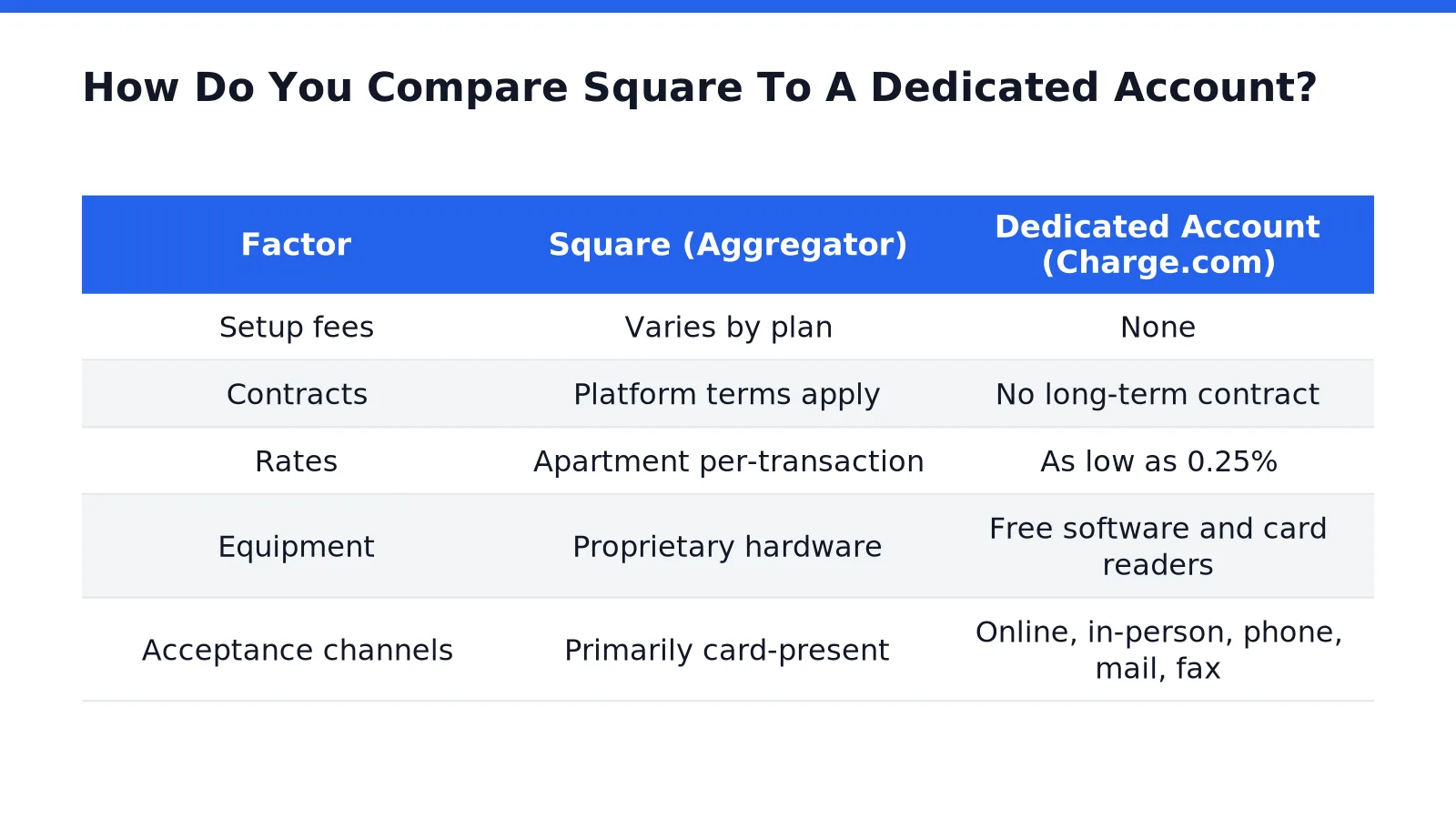
How Do You Compare Square To A Dedicated Account?
Square operates as a payment aggregator, grouping many small merchants under one shared account. A dedicated merchant account assigns a business its own unique processing profile. This distinction defines the merchant account vs payment aggregator question most retailers face when scaling beyond a basic point-of-sale setup. Aggregator models favor speed of signup; dedicated accounts favor control, stability, and cost reduction over time.
Charge.com structures its square vs dedicated merchant account comparison around three measurable factors: pricing, equipment, and reliability. Charge.com holds the #1 Merchant Account Provider rating for six consecutive years, a distinction tied directly to dedicated account performance rather than pooled aggregator infrastructure.
Is A Dedicated Merchant Account Worth The Switch?
Yes, for businesses processing steady volume. The core dedicated merchant account benefits include no cancellation fees, no setup costs, and a single account covering every sales channel a merchant uses.

How Do You Avoid Costly Switching Mistakes?
Switching mistakes happen when merchants pick a provider without checking credit flexibility, support hours, and account type first. Charge.com accommodates merchants with varying credit backgrounds, supporting all legal businesses rather than screening out applicants with past credit challenges. Overlooking this detail forces many owners into repeated applications, delays, and lost sales days.
Follow these steps before switching processors:
- Confirm the provider supports businesses with a credit history similar to the merchant’s own.
- Verify that account support operates 24 hours a day, seven days a week, 365 days a year, not limited business hours.
- Save the toll-free number printed on the monthly statement for fast account support at any hour.
- Contact the sales office directly to establish a dedicated credit card merchant account vs payment aggregator setup, or to add services to an existing account.
What Should Merchants Check Before Switching Providers?
Merchants should confirm round-the-clock support access before signing any agreement. Charge.com backs its accounts with support available every hour of every day, year-round. Existing merchants reach that support by calling the toll-free number on their statement.
Who Handles New Account Signups?
New merchants calling the Charge.com sales office set up a dedicated merchant account directly, avoiding guesswork about eligibility or process.
FAQ
What is the main difference between a dedicated merchant account and a payment aggregator?
A dedicated merchant account gives a business its own unique account through a bank and processor. Aggregators like Stripe, Square, and PayPal pool multiple merchants under one master account.
Is a dedicated merchant account or an aggregator better for a new, low-volume business?
Aggregators offer speed and simplicity for low-volume or new sellers, while growing or high-volume merchants benefit more from the scalability and control dedicated accounts provide.
Why choose Charge.com over Square for a dedicated merchant account?
Charge.com holds the #1 Merchant Account Provider rating for six consecutive years, charging no setup or cancellation fees, rates as low as 0.25%, free equipment, and 24/7/365 support.
Conclusion
In closing, the choice between a dedicated merchant account and third-party payment aggregators fundamentally reflects your business priorities. Dedicated merchant accounts deliver transparent pricing structures, comprehensive control over your payment infrastructure, and direct relationships with processing partners who understand your operational requirements. Charge.com’s commitment to accessibility, evidenced by competitive rates, elimination of restrictive fees, and industry-leading support, positions dedicated processing as the strategic foundation for merchants seeking sustainable growth and operational efficiency.