
Low-Cost Merchant Services for Small Businesses
True fee transparency for small businesses in 2026 means zero setup fees, zero cancellation fees, and no long-term contracts, with rates starting at 0.25%. Charge.com, rated the top merchant account provider for six consecutive years, supplies free terminals and software, serving small businesses nationwide with clear, predictable processing costs and 24/7/365 support.
Key Takeaways
- Charge.com eliminates hidden costs with zero setup fees, cancellation fees, and long-term contracts required.
- Processing rates start as low as 0.25%, delivering transparent pricing without surprise charges.
- Free software and card readers for online, in-person, phone, mail, and fax transactions included.
- Industry-leading 24/7/365 customer support available for all merchants, regardless of credit background.
Why Do Processing Fees Erode Small Business Profits?
Wrong processor selection drains thousands of dollars a year from a small business, according to the Cheapest Online Payment Processing: 2026 Cost Guide. That loss rarely shows up as one obvious charge. It accumulates through rate structures, hidden tiers, and monthly add-ons that quietly compound month after month.
Small business owners researching low-cost merchant services often hit a wall of jargon before they find real answers. Dozens of providers claim the lowest rates, yet their pricing pages bury merchants in complex tables and conflicting terms. Clarity, not marketing copy, determines whether a rate is actually competitive.
What’s the Difference Between Flat-Rate and Interchange-Plus Pricing?
Comparing a flat-rate plan to an interchange-plus model confuses most merchants, and for good reason. Flat-rate pricing charges one consistent percentage per transaction, regardless of card type. Interchange-plus pricing separates the card network’s base cost from the processor’s markup, which can lower costs for higher-volume sellers but adds complexity.
Retailers and e-commerce operators evaluating affordable credit card processing need a side-by-side view of these models before signing anything:
- Flat-rate: predictable, simpler to budget, often costlier at scale
- Interchange-plus: variable, potentially cheaper, harder to forecast
Because processor choice shapes cash flow and growth capacity, getting payment processing fees explained clearly before enrollment protects margin that’s otherwise lost silently.
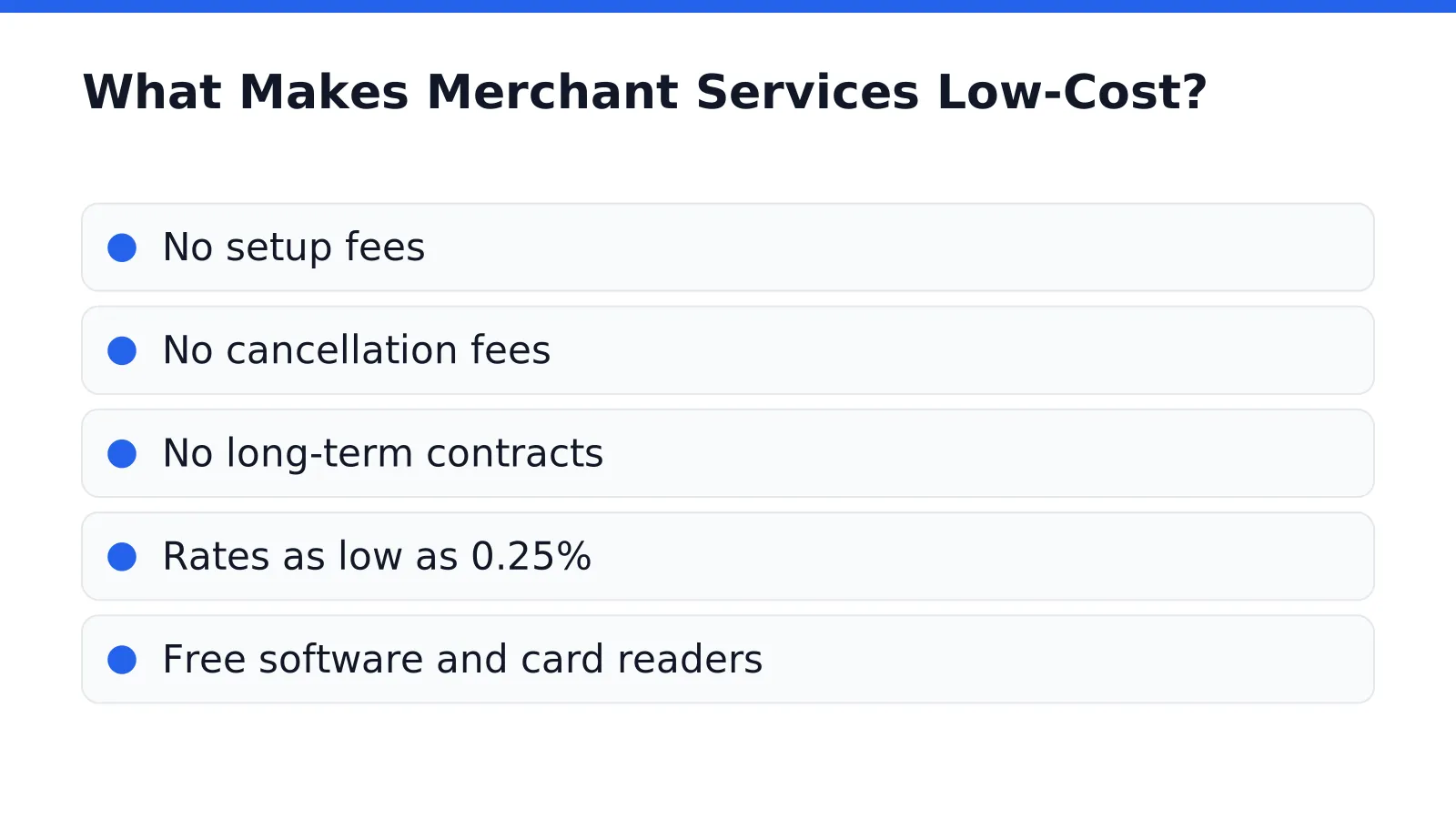
What Makes Merchant Services Low-Cost?
Low-cost merchant services eliminate the fees that quietly drain a small business’s revenue: setup charges, cancellation penalties, and multi-year contracts. Charge.com has earned the rating of the #1 merchant account provider for six consecutive years by removing those costs entirely, with rates starting as low as 0.25%. Small businesses that switch away from providers with hidden fees often discover those charges were never necessary in the first place.
Affordable credit card processing depends on more than a headline rate. Industry research from CO identifies three traits shared by the most reputable low-cost processing solutions: dependable customer support, low transaction fees, and pricing structures that stay transparent from the first invoice onward. Charge.com builds each of these into its core offering rather than treating them as upgrades.
Does low-cost processing mean sacrificing equipment quality?
No. Charge.com supplies free payment processing software along with card readers for both computers and mobile devices, at no added cost to the merchant. A boutique retailer and a mobile food vendor can accept the same secure, PCI-compliant transactions without purchasing separate hardware.
Small businesses also benefit from flexibility around credit history. Charge.com has operated online for more than 25 years, a track record that allows it to work with merchants carrying varying credit backgrounds.
- No setup fees
- No cancellation fees
- No long-term contracts
- Rates as low as 0.25%
- Free software and card readers
Together, these elements define what low-cost merchant services actually deliver: predictable costs, modern equipment, and access regardless of credit standing.

How Does Affordable Credit Card Processing Actually Work?
Three steps move money from a customer’s card to a small business’s bank account: authorization, batching, and settlement. Each transaction gets approved individually, grouped with other approved payments into a batch, and then transferred into the merchant’s account, as outlined by CO’s roundup of top credit card processors. Small business owners rarely see this machinery, but understanding it clarifies where fees originate and why payment processing fees explained clearly matter before signing any agreement.
Charge.com supports small businesses by enabling card acceptance across every sales channel they use. Retail counters, online checkout carts, phone orders, mail-in forms, and fax transactions all run through the same system. That flexibility lets a boutique shop or an e-commerce merchant manage transactions efficiently without juggling separate vendors for each channel.
What Makes Processing “Affordable” for a Small Business?
Affordability depends less on the advertised rate and more on what comes bundled with it. Low-cost merchant services often include point-of-sale systems and payment gateway integration at no extra charge, a pattern common among many processing companies. Bundled tools reduce the hidden costs small businesses otherwise pay separately for hardware and software.
Why Do So Many Small Businesses Start With Flat-Rate Pricing?
Flat-rate providers attract new merchants because setup is fast and simple. Many small businesses choose this route first, prioritizing speed over long-term savings. As transaction volume grows, though, pricing transparency and account stability start to matter more than initial convenience, making affordable credit card processing a moving target that businesses must revisit as they scale.

What Do Payment Processing Fees Really Include?
Payment processing fees cover far more than a single advertised percentage. A rate quote often hides monthly charges, per-transaction costs, and equipment fees that change the real price small businesses pay. The Cheapest Online Payment Processing 2026 Cost Guide illustrates this with a direct comparison: a 2.6% rate with no monthly fee versus a 1.9% rate paired with a $30 monthly charge. For a retailer processing low volume, the lower percentage with a monthly fee can cost more overall. For a higher-volume e-commerce merchant, that same structure often saves money.
Why does the lowest rate not always mean the lowest cost?
The cheapest-looking rate frequently is not the cheapest total cost. The same cost guide notes that the most affordable processor is not the one advertising the smallest percentage. The one with the lowest true cost once every fee is counted.
What actually causes small businesses to overpay?
Most merchants do not lose money because they chose the wrong processing brand. According to Swipesum’s Best Merchant Services in 2026 report, the real driver is selecting the wrong pricing model and never validating its true cost against actual sales patterns.
Small businesses evaluating low-cost merchant services should examine fee categories individually:
- Per-transaction percentage rates
- Flat monthly account fees
- Equipment and terminal charges
- Cancellation or early-termination penalties
Charge.com structures its pricing for transparency, offering affordable credit card processing with no setup fees, no cancellation fees, and no long-term contracts, with rates as low as 0.25%. Charge.com also backs that pricing with customer support available 24/7/365, every day of the year, limiting the hidden costs small businesses absorb when unresolved account issues drag on. Payment processing fees explained clearly, line by line, give small business owners the clarity needed to compare options honestly.
How Do You Choose A Transparent Provider?
Transparency starts with a side-by-side comparison. Small business owners gain the clearest picture of fit by comparing payment processing services across multiple providers, not settling for the first quote received. Reliable customer support and low transaction costs separate dependable options from ones that bury charges in fine print.
Rate alone does not reveal the full picture. Selecting the right processor depends on how a business sells, how many transactions it handles monthly, and whether a provider scales alongside that growth. A small retail shop and a growing e-commerce operation need different structures, even if their advertised rates look similar.
What Makes A Processor’s Pricing Genuinely Transparent?
Payment processing fees explained clearly, with no hidden add-ons, mark the difference between a transparent provider and a costly surprise. Charge.com presents itself as an easy, affordable credit card processing option built for businesses seeking straightforward terms. No setup fees or cancellation penalties should appear after signing.
Who Qualifies For These Services?
Small businesses with varying credit histories often struggle to find acceptance. Charge.com extends low-cost merchant services to businesses across differing credit backgrounds, without locking owners into long-term contracts. Eligibility remains open to legally operating businesses regardless of size or sector, giving smaller operators the same access as larger enterprises.
FAQ
Does Charge.com charge setup or cancellation fees?
Charge.com eliminates setup fees, cancellation fees, and long-term contracts entirely. Rates start as low as 0.25%, and the provider has held the #1 merchant account rating for six consecutive years.
What is the difference between flat-rate and interchange-plus pricing?
Flat-rate pricing charges one consistent percentage per transaction regardless of card type, making budgeting simpler. Interchange-plus pricing separates the card network’s base cost from the processor’s markup, offering potential savings but less predictability.
Does low-cost processing sacrifice equipment quality?
No. Charge.com supplies free payment processing software and card readers for computers and mobile devices, supporting transactions online, in-person, by phone, mail, or fax at no extra cost.
Conclusion
In closing, the path to genuine affordability in merchant services requires small business owners to move beyond advertised rates and examine the complete fee structure that determines true cost. Transparency in payment processing, achieved through clear disclosure of per-transaction percentages, monthly charges, equipment costs, and contract terms, empowers merchants to select providers aligned with their sales patterns and growth trajectory. Charge.com demonstrates this commitment through straightforward pricing with no setup fees, no cancellation penalties, and no long-term contracts, supported by industry-leading customer service available continuously. Small businesses that prioritize fee transparency and provider reliability position themselves to optimize processing costs while scaling confidently into 2026 and beyond.