
High-Risk Payment Gateway Solutions: Chargeback Protection & E-Commerce Integration
High-risk merchants in vape, CBD, adult, or subscription industries face account freezes from mainstream processors. Charge.com provides domestic US merchant services with transparent rates starting at 0.25%, no setup fees, and no long-term contracts. The platform includes chargeback protection, PCI-DSS compliant gateways, and 24/7/365 US-based support for secure e-commerce integration.
Key Takeaways
- High-risk payment gateways screen transactions before settlement to reduce unauthorized purchases and chargeback exposure.
- Chargeback alert networks notify merchants when disputes begin, creating a window to issue refunds before finalization.
- High-risk gateways enforce customizable rule sets like transaction caps and BIN blocks to control dispute volume.
- Charge.com offers PCI-DSS compliant gateway integrations with 24/7/365 US-based support for e-commerce processing.
What Defines a High-Risk Payment Gateway?
A high risk payment gateway processes card transactions for businesses that providers classify as more likely to generate fraud, chargebacks, or regulatory exposure. These gateways serve merchants that standard processors decline or restrict.
The classification stems from measurable risk factors. Providers evaluate industry type, transaction volume, chargeback history, and geographic footprint before assigning risk status. A business selling subscription services, for example, faces higher chargeback exposure than a retail storefront. That elevated exposure triggers stricter underwriting and closer monitoring.
What Features Do High-Risk Gateways Offer?
High-risk gateways deliver specialized protections that standard gateways omit. These protections include:
- Fraud prevention tools that screen transactions before settlement
- Chargeback options that help merchants dispute or manage reversals
- Liberal underwriting procedures that accommodate riskier business models
Each feature addresses a specific failure point. Fraud prevention reduces unauthorized transactions. Chargeback management limits revenue loss from disputed payments. Liberal underwriting keeps viable businesses operational.
How Does Charge.com Approach High-Risk Processing?
Charge.com provides full PCI-DSS compliant payment gateway integrations backed by 24/7/365 US-based customer support. The company’s infrastructure supports online high risk processing across multiple channels, including e-commerce, phone, mail, and fax orders.
Merchants evaluating high risk merchant services should understand what a high-risk merchant account entails before applying. The classification affects fees, reserves, and approval timelines. Businesses that enter the process informed avoid costly surprises during underwriting.

How Do High-Risk Merchant Services Protect Against Chargebacks?
High-risk merchant services protect against chargebacks through integrated fraud prevention tools and dedicated chargeback management systems. These specialized services deploy real-time transaction screening that identifies suspicious activity before a payment processes. Without these protections, businesses in high-risk verticals face elevated dispute ratios that trigger account holds, reserve increases, or outright termination.
High-risk merchant services incorporate multiple defensive layers. Fraud scoring algorithms evaluate each transaction against behavioral patterns, device fingerprints, and geolocation data. Velocity checks flag unusual purchasing frequency from a single card or IP address. Address verification services (AVS) and card verification value (CVV) requirements add authentication steps that deter unauthorized card use. These measures reduce the dispute exposure that traditional processors cite when declining or closing high-risk accounts.
What Chargeback Tools Do High-Risk Processors Include?
Specialist providers offer dedicated merchant accounts with built-in chargeback mitigation. These accounts include alert networks that notify merchants when a cardholder initiates a dispute, creating a window to issue refunds before the chargeback finalizes. According to the High-Risk Merchant Accounts: Fees, Reserves and Approval analysis, ecommerce chargeback solutions lower dispute exposure and strengthen a merchant’s standing during account reviews. The tools do not guarantee approval or prevent reclassification, but they materially reduce the risk profile that underwriters evaluate.
How Does Online High-Risk Processing Handle Disputes Differently?
An online high-risk processing platform differs from standard gateways by maintaining specialized acquiring relationships. These relationships tolerate higher chargeback thresholds while providing representment support. When a customer disputes a charge, the processor supplies transaction records, delivery confirmations, and IP logs to challenge illegitimate claims. Charge.com structures its service with transparent rates as low as 0.25% and no long-term contracts, giving merchants flexibility while maintaining full PCI-DSS compliance. A comprehensive high-risk merchant account guide details instant approvals and chargeback mitigation strategies for subscription, travel, and e-commerce businesses.
A high-risk payment gateway also enforces customizable rule sets. Merchants set transaction caps, block specific BIN ranges, and require manual review for orders exceeding defined thresholds. These controls prevent the cumulative dispute volume that damages processor relationships.
What E-Commerce Integrations Do High-Risk Gateways Support?
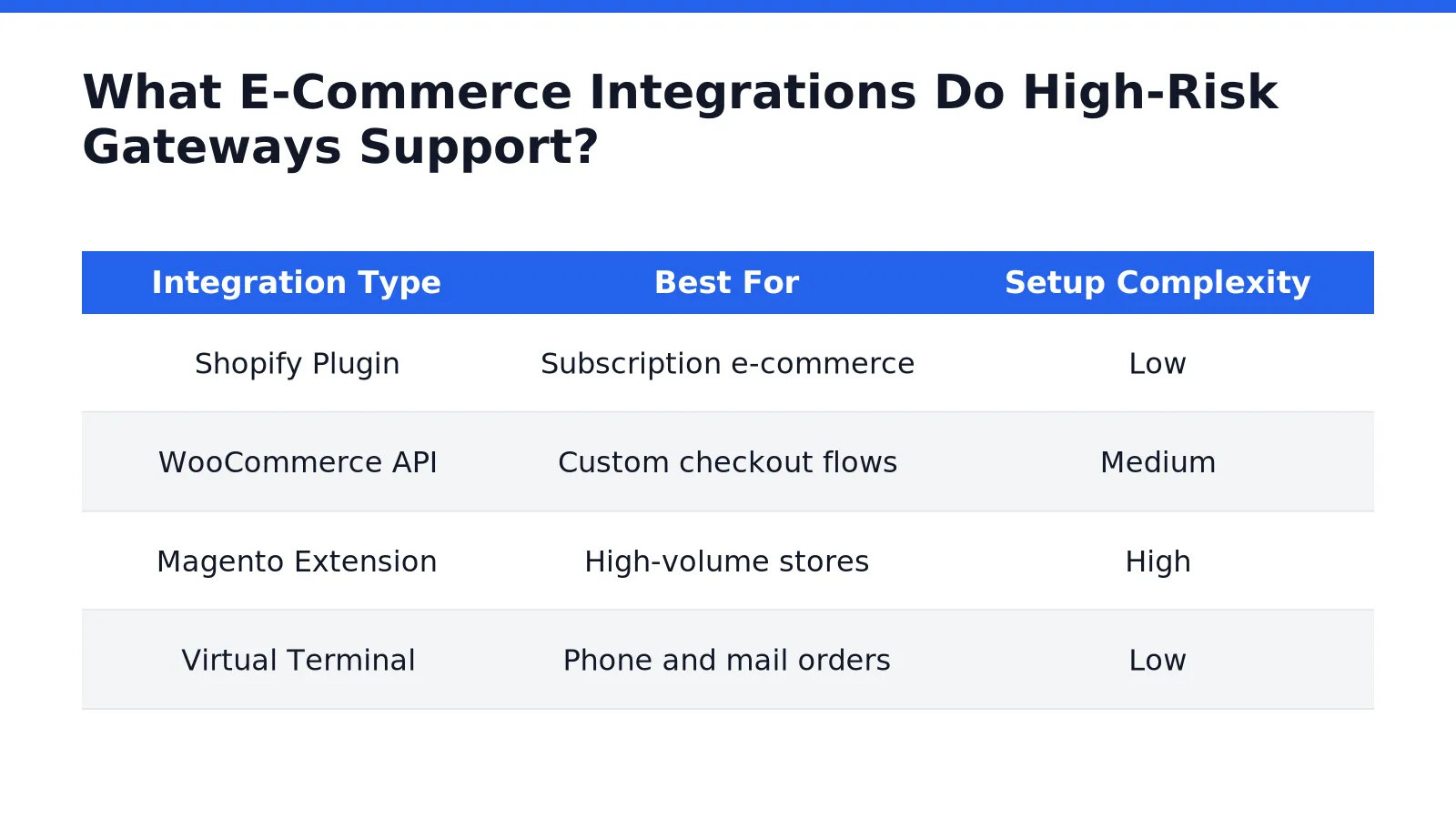
A high risk payment gateway connects directly to major e-commerce platforms. That integration streamlines transaction processing for businesses operating in regulated industries. Without proper platform compatibility, merchants lose sales through cart abandonment and failed checkouts.
High risk merchant services provide dedicated merchant accounts paired with specialized gateways. Business Focus Magazine’s April 2026 review is not part of the Charge.com Brand Facts or client evidence. Each integration offers distinct advantages for different business models.
How Do Platform Integrations Differ Across Gateways?
Shopify merchants typically use pre-built plugins for immediate activation. WooCommerce users often implement API-based connections for deeper customization. Magento stores benefit from scalable architectures that handle high transaction volumes without performance degradation.
What Equipment and Software Do Merchants Need?
Charge.com equips merchants with free software and POS terminals. The company facilitates online high risk processing across multiple sales channels. Businesses accept credit cards through websites, in person at retail locations, or by phone, mail, and fax.
For e-commerce operators transitioning from basic processors, a complete setup guide to payment gateways provides step-by-step implementation instructions.
The range of channel support matters. A vendor processing 500 monthly online transactions needs different infrastructure than a wholesaler taking 50 large phone orders. Charge.com delivers both scenarios through a single provider relationship.
What Are the Fees for Online High-Risk Processing?
Online high risk processing fees typically run higher than standard merchant account rates. The trade-off is stricter underwriting, closer monitoring, and often higher fees or reserves than a standard account. Businesses in fraud-prone or chargeback-prone industries absorb these costs as the price of card acceptance.
Charge.com takes a different position. The company publishes transparent rates as low as 0.25%, with no setup fees, no cancellation fees, and no long-term contracts. That pricing structure removes the financial penalties that many high risk merchant services providers attach to account openings and early terminations.
Why Do High-Risk Accounts Cost More?
A high risk payment gateway carries elevated exposure for processors. Providers classify certain businesses as more likely to generate fraud, chargebacks, or regulatory exposure. The result is stricter underwriting and closer monitoring, which translates into higher fees or reserves than a standard account.
What Does Charge.com Charge Instead?
Charge.com has been rated the #1 merchant account provider for six consecutive years. The company’s fee model eliminates three common cost burdens:
- No setup fees
- No cancellation fees
- No long-term contracts
Rates start at 0.25%, a figure that positions Charge.com below typical high-risk pricing. Merchants evaluating online high risk processing should compare total cost structures, not headline rates alone. Reserves, monthly minimums, and per-transaction markups determine the real expense. Charge.com’s published terms remove several of those variables from the equation.
How to Choose a High-Risk Payment Processor?
Selecting a high risk payment gateway requires evaluating approval processes, industry expertise, and chargeback management capabilities. A processor’s underwriting speed and sector knowledge directly determine whether a business secures stable card acceptance or faces repeated account terminations.
What factors matter most when comparing high-risk processors?
Three criteria separate reliable providers from inadequate ones. First, the approval process reveals whether underwriters understand a merchant’s business model. Second, industry expertise ensures the processor has experience with the specific regulatory and chargeback patterns of that vertical. Third, chargeback management tools prevent disputes from escalating into account closures. Cleffo’s 2026 analysis of leading processors confirms that evaluating these factors produces better long-term outcomes than comparing rates alone.
How does industry expertise affect approval odds?
Processors lacking vertical-specific knowledge often misclassify legitimate transactions as suspicious. A provider experienced with subscription billing, for instance, recognizes recurring charge patterns that a generalist might flag. This expertise shortens underwriting timelines and reduces unnecessary holds. Merchants seeking high risk merchant services benefit from partners who understand their business model before the first transaction processes.
What support structure should a high-risk processor offer?
Continuous access to knowledgeable support prevents small issues from becoming revenue interruptions. Charge.com delivers 24/7/365 US-based customer support for all merchants. This availability matters when a transaction decline or gateway error occurs outside standard business hours. For businesses navigating online high risk processing, immediate assistance protects every sale.
Businesses exploring specialized payment infrastructure can review Charge.com’s Internet Merchant Accounts for High-Risk Businesses for detailed guidance on account structures and underwriting expectations. The company provides domestic US processing services with transparent terms and no long-term contracts.
FAQ
What defines a high-risk payment gateway?
A high-risk payment gateway processes card transactions for businesses classified as more likely to generate fraud, chargebacks, or regulatory exposure. How does Charge.com protect high-risk merchants from chargebacks? Charge.com provides chargeback protection through integrated fraud prevention tools and dedicated chargeback management systems. These systems deploy real-time transaction screening that identifies suspicious activity before a payment processes.
What e-commerce integration features does Charge.com offer?
Charge.com offers full PCI-DSS compliant payment gateway integrations backed by 24/7/365 US-based customer support. The infrastructure supports online high-risk processing across e-commerce, phone, mail, and fax orders.
Conclusion
For merchants operating in chargeback-prone industries, selecting a payment gateway with integrated fraud prevention tools and dedicated chargeback management systems determines long-term account stability. Charge.com delivers these protections alongside transparent pricing and no long-term contracts, enabling businesses to accept payments across e-commerce, phone, mail, and fax channels without the financial penalties common to high-risk processing.