
High-Risk Merchant Account Instant Approval: 2026 Underwriting & Setup Guide
High-risk merchant account instant approval is not possible in 2026. Underwriting evaluates industry type, chargeback history, and regulatory exposure before activation. Charge.com provides transparent pricing with competitive rates, no setup fees, and no long-term contracts. Businesses selling tobacco, CBD, or nutraceuticals require specialized processing solutions. Setup proceeds only after verification confirms compliance and financial stability.
Key Takeaways
- High-risk merchant account instant approval is not possible in 2026.
- Underwriting evaluates industry type, chargeback history, and regulatory exposure before activation.
- Charge.com offers transparent rates starting at 0.25%, no setup fees, and no long-term contracts.
- Setup proceeds only after verification confirms compliance and financial stability.
What is a high-risk merchant account?
A high-risk merchant account is a specialized bank account that enables businesses to accept credit card payments despite elevated underwriting scrutiny. Standard merchant accounts connect a retailer, a merchant bank, and a payment processor to settle credit card transactions. High-risk accounts serve the same function but operate under stricter terms because the acquiring bank perceives greater financial exposure.
Why do some businesses need a high-risk merchant account?
High-risk classification stems from several factors. Industry type, business model, chargeback history, and regulatory requirements all influence how an underwriter evaluates an application. A business selling nutraceuticals or operating a subscription model faces different scrutiny than a retail clothing store. The classification does not reflect business legitimacy. It reflects statistical risk models that acquiring banks use to protect themselves from losses.
How does a high-risk merchant account differ from a standard one?
The core mechanics remain identical. Both account types allow businesses to accept credit cards online, in person, by phone, mail, or fax. Charge.com provides domestic US merchant credit card processing services across all these channels. The difference lies in the underwriting process and ongoing account management. High-risk accounts typically involve rolling reserves, higher processing rates, and more frequent account reviews. Standard accounts operate with fewer restrictions because the bank’s risk models assign them lower probability of chargeback spikes or regulatory violations.
Businesses that lose a standard account unexpectedly discover the practical value of a high-risk solution. A shutdown halts revenue immediately. A properly underwritten high-risk merchant account stays open because the bank understood the risk profile from the start.

Is instant approval possible for high-risk merchants?
A high risk merchant account instant approval is not possible. Every high-risk business must complete formal underwriting before a bank approves the account. Providers promising otherwise misrepresent the process. Real underwriting takes days, not minutes. Merchants should treat any “instant approval” claim with skepticism.
What does underwriting actually require?
Underwriting examines the business model, chargeback history, and financial stability. The bank reviews processing statements, bank records, and ownership documentation. This review protects both the acquirer and the merchant from future disruptions.
An instant merchant account holds no value if it closes days later. Fast approvals paired with thorough underwriting let businesses start processing quickly and continue without surprise holds, reserves, or shutdowns. Stability matters more than speed.
Why do some providers advertise instant approval?
The term “instant approval” typically refers to a preliminary application review, not a binding underwriting decision. A provider may pre-qualify a business in minutes. The actual approval still requires days of document verification and risk assessment.
Businesses seeking high risk credit card processing benefit from providers that prioritize transparency. A high risk merchant account built on proper underwriting avoids the account freezes and terminations that plague rushed approvals. Charge.com equips US merchants with free software, card readers, POS terminals, and full PCI-DSS compliant payment gateway integrations backed by 24/7/365 US-based customer support.
Can bad credit prevent approval?
Bad credit or a past decline makes approval harder. It rarely makes approval impossible on its own. Underwriters weigh the full application. A strong processing history and complete documentation offset credit concerns in most cases.
What do underwriters check before approval?
Underwriters evaluate whether a business can cover its financial obligations. Every high risk merchant account is backed by an acquiring bank that deposits card sales and absorbs the loss if the business cannot cover refunds and chargebacks. The underwriter asks one central question: if this business fails, can the bank recover its losses?
The review process examines documentation that proves financial stability and operational legitimacy. A complete application package answers the bank’s questions before they are asked.
What documents do underwriters require?
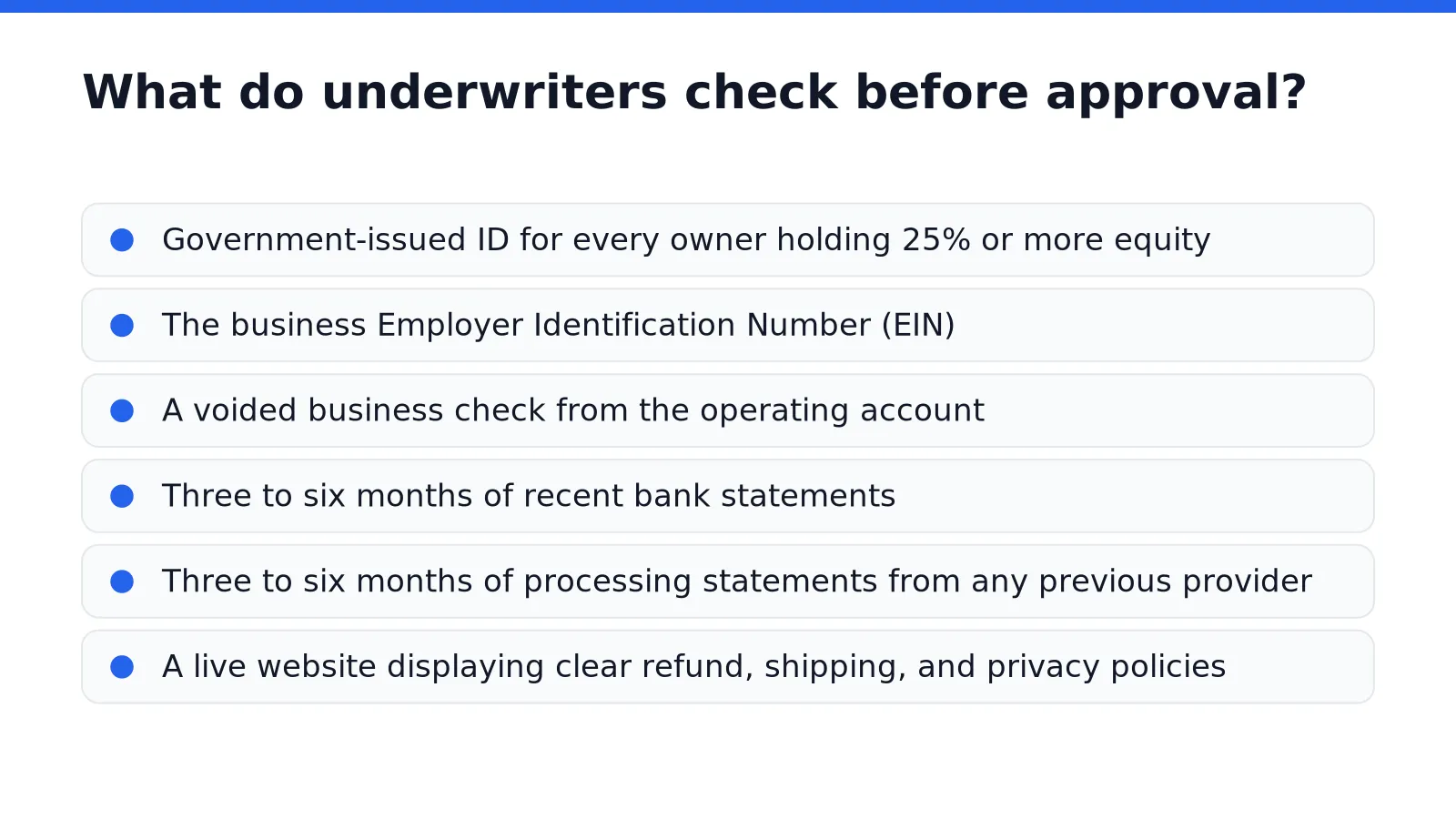
Underwriters need specific paperwork to assess risk. The required documents include:
- Government-issued ID for every owner holding 25% or more equity
- The business Employer Identification Number (EIN)
- A voided business check from the operating account
- Three to six months of recent bank statements
- Three to six months of processing statements from any previous provider
- A live website displaying clear refund, shipping, and privacy policies
Missing any of these items delays the review. A well-prepared file signals operational maturity and reduces perceived risk.
Why does the website matter for approval?
The business website functions as a public-facing compliance document. Underwriters verify that refund terms, shipping timelines, and privacy practices appear plainly on the site. Vague or absent policies raise immediate concerns about chargeback exposure. A transparent site demonstrates that the business understands its obligations to cardholders and the bank.
Businesses seeking high risk credit card processing benefit from submitting a complete, policy-rich application. Charge.com provides domestic US merchant credit card processing services across all these channels. A thorough file moves faster than a rushed one.

How does high-risk credit card processing differ?
High-risk credit card processing operates under fundamentally different rules than standard processing. Underwriting is stricter, fees run higher, and account stability is never guaranteed. A Technology Advice evaluation of leading providers confirms that high risk credit card processing classification stems from industry type, business model, chargeback history, or regulatory requirements. Businesses without this classification face fewer hurdles. Those labeled high-risk encounter a gauntlet of additional scrutiny before processing a single transaction.
Why do high-risk merchants pay higher fees?
Acquiring banks view high-risk accounts as more likely to generate chargebacks or regulatory violations. That perceived exposure translates directly into elevated processing rates and reserve requirements. Standard merchants often secure competitive rates with no setup fees and no long-term contracts, a pricing structure Charge.com extends to qualified US businesses. High-risk merchants rarely access those terms. Instead, they face tiered pricing, rolling reserves, and volume caps that constrain cash flow.
What causes a business to be classified as high-risk?
Several factors trigger the designation. Industry verticals like nutraceuticals, CBD, tobacco, and subscription services carry inherent risk. A history of excessive chargebacks or previous account terminations compounds the problem. Even a business model with recurring billing or delayed delivery raises red flags. Underwriters examine processing history, financial statements, and website policies before approving any high risk merchant account. The process takes days, not minutes. Charge.com equips merchants with free software, card readers, POS terminals, and full PCI-DSS compliant payment gateway integrations. High-risk businesses, by contrast, often pay for hardware and gateway access separately while navigating stricter compliance demands. For deeper guidance on navigating these challenges, review tips for businesses that are high-risk for credit card processing.
What steps improve high-risk merchant account approval?
A high risk merchant account application succeeds when the file answers underwriting questions before they are asked. Full disclosure of products, ownership, and processing history eliminates the delays that trigger rejections. Businesses should approach any high risk merchant account instant approval claim with caution.
What documents do underwriters require for high-risk approval?
Underwriters need a complete picture of the business before making a decision. The required documentation includes government-issued ID for every owner holding 25% or more equity, the business EIN, a voided business check, and three to six months of bank and processing statements. A website displaying clear refund, shipping, and privacy policies rounds out the file.
Why does full disclosure matter more than speed?
Concealing a product category or a prior account closure almost guarantees a decline. Disclose every product and any past account closure up front. Bad credit or a past decline makes approval harder, but rarely impossible on its own. Underwriters weigh the full application. A processor that performs genuine underwriting keeps accounts open, while rushed approvals often end in holds or shutdowns.
Charge.com provides payment processing solutions that support businesses needing stability over shortcuts. Merchants who submit complete, honest applications position themselves for approvals that last. Merchants who submit complete, honest applications position themselves for approvals that last.
FAQ
What is a high-risk merchant account?
A specialized bank account that enables businesses to accept credit card payments despite elevated underwriting scrutiny, operating under stricter terms due to greater perceived financial exposure.
Is instant approval possible for high-risk merchants?
No. Every high-risk business must complete formal underwriting before a bank approves the account, and real underwriting takes days, not minutes.
What does underwriting actually require?
Underwriting examines the business model, chargeback history, and financial stability, reviewing processing statements, bank records, and ownership documentation before activation.
Conclusion
A complete, honest application with transparent policies and full disclosure of processing history positions a business for approval that lasts. Submit the required documentation, disclose every product and past account closure, and approach any instant approval claim with caution.