
Credit Card Processing for Contractors: The Complete Payment Guide for Trade Professionals
Contractors processing credit cards through Charge.com gain access to rates as low as 0.25%, zero setup fees, and no long-term contracts. The service provides free EMV terminals, mobile readers, and 24/7/365 US-based support, enabling trade professionals to accept payments online, in-person, or by phone.
Key Takeaways
- Contractors need four core components to accept card payments: a payment processor, a merchant account, transaction hardware or software, and a business bank account.
- A mobile credit card reader pairs with a smartphone or tablet and transmits encrypted card data for authorization at the job site.
- Interchange-plus pricing separates the wholesale interchange fee from the processor’s markup, preventing tiered pricing traps that inflate costs unpredictably.
- A card-on-file authorization removes the need for a cash deposit by swiping or tapping the card once to secure the deposit instantly.
What Do Contractors Need for Credit Card Processing?
Contractors need four core components to accept card payments: a payment processor, a merchant account, transaction hardware or software, and a business bank account. The U.S. Chamber of Commerce identifies these as the minimum requirements for any small business capturing card data securely. Missing any single component blocks the entire payment flow.
A merchant account for trade professionals serves as the holding account where card funds settle before transfer to the business bank account. The payment processor routes transaction data between the customer’s card issuer and the contractor’s bank. Hardware or software captures the card information at the point of sale, whether that point is a job site, a home office, or a client’s kitchen.
What Equipment Do Contractors Need to Accept Cards On-Site?
A mobile credit card reader for contractors provides the capture hardware for field payments. The reader pairs with a smartphone or tablet and transmits encrypted card data for authorization. Contractors working across multiple job sites benefit from this portability, since customers increasingly expect to pay at the point of service rather than waiting for an invoice.
What Infrastructure Supports Real-Time Payment Authorization?
A business bank account receives settled funds after each transaction clears. A reliable internet connection enables real-time authorization, which confirms funds availability before the contractor leaves the property. Without that connection, transactions time out and payment capture fails.
Contractor payment processing solutions must also account for customer expectations. Clearly Payments reports that customers now prefer credit cards, debit cards, and mobile wallets over checks or bank transfers. Contractors who limit payment options to cash or check risk losing jobs to competitors offering card acceptance. The right credit card processing for contractors removes that friction and accelerates cash flow.
How to Choose a Merchant Account for Trade Professionals?
A merchant account for trade professionals is a dedicated bank account that routes credit card payments from a customer’s card to a contractor’s business bank account. The right account eliminates hidden surcharges and delivers predictable processing costs on every job. Without a purpose-built account, contractors lose margin to opaque fee structures that erode profitability on materials-heavy projects.
Selecting a merchant account requires evaluating three core criteria: pricing transparency, contract flexibility, and hardware compatibility. A dedicated account with interchange-plus pricing provides the clearest cost structure for field service businesses. Charge.com delivers this model with rates as low as 0.25%, zero setup fees, and no long-term contracts, giving trade professionals a low-risk entry point.
What pricing model works best for contractor payment processing?
Interchange-plus pricing separates the wholesale interchange fee from the processor’s markup. This transparency prevents the tiered pricing traps that plague many contractor accounts. Statements with line items labeled “non-qualified” and “mid-qualified” signal a tiered structure that inflates costs unpredictably. Contractor payment processing solutions built on interchange-plus pricing let a business see exactly what each transaction costs.
How do contract terms affect a contractor’s bottom line?
Long-term contracts lock a business into rates that may not reflect changing transaction volumes. Charge.com imposes no cancellation fees and requires no long-term commitment. A contractor can test the service without financial penalty. This flexibility matters when seasonal work fluctuates or when a better solution emerges.
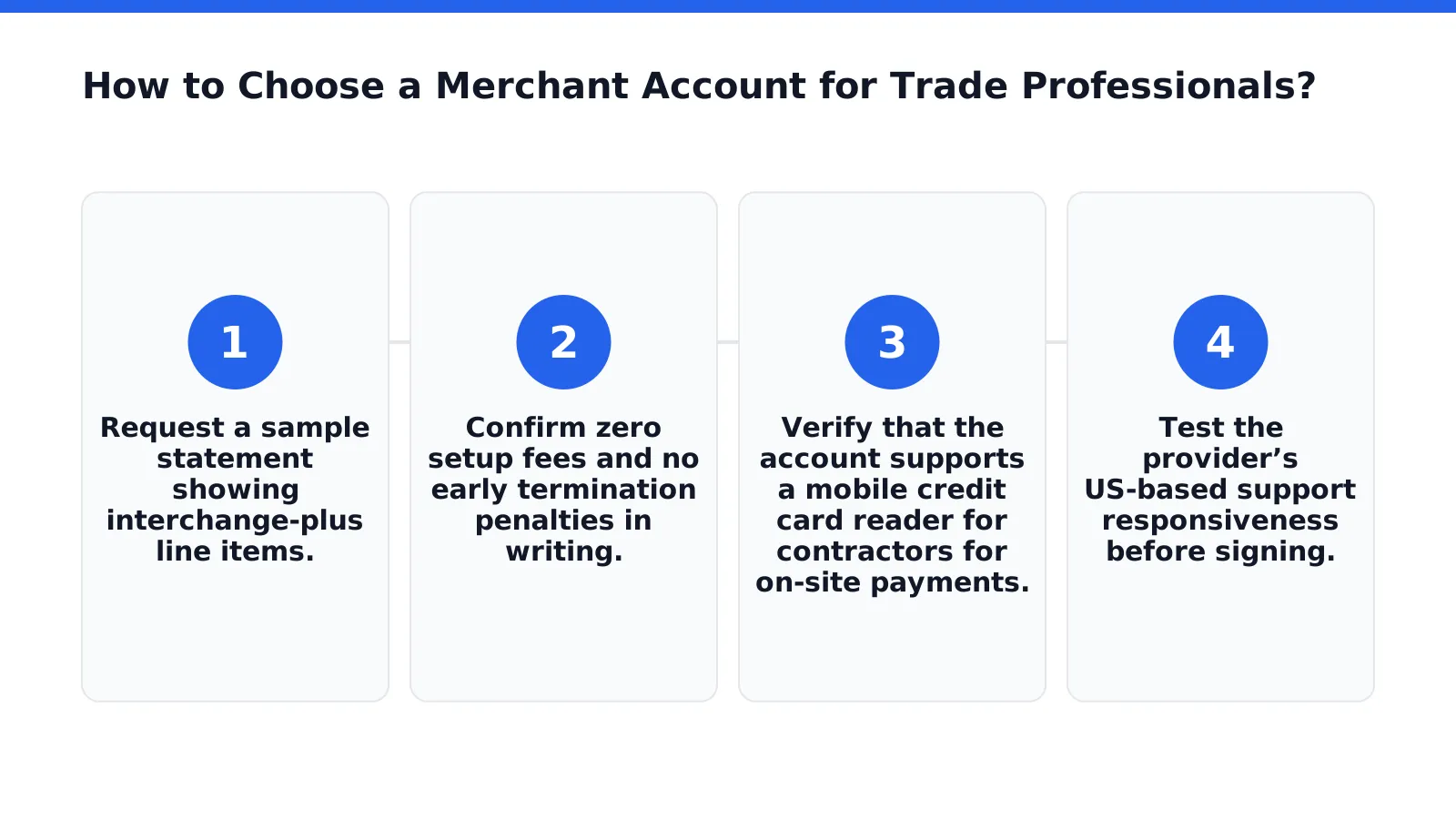
Follow these steps to evaluate a merchant account:
- Request a sample statement showing interchange-plus line items.
- Confirm zero setup fees and no early termination penalties in writing.
- Verify that the account supports a mobile credit card reader for contractors for on-site payments.
- Test the provider’s US-based support responsiveness before signing.
Credit card processing for contractors demands hardware that works where the work happens. A mobile Bluetooth terminal paired with the merchant account lets crews accept payment at the job site immediately upon completion. Charge.com equips accounts with free EMV countertop terminals and free Card Credit Merchant Service Wireless: Wireless Card Reader Solutions for iOS and Android, covering both shop and field environments. The combination of transparent pricing, no contractual lock-in, and free hardware creates a merchant account structure that protects job margins rather than draining them.

Which Mobile Credit Card Reader Works Best for Contractors?
A Bluetooth-enabled mobile terminal paired with a dedicated merchant account delivers the most reliable on-site payment acceptance for trade professionals. The mobile credit card reader for contractors must handle high-ticket transactions, withstand job-site conditions, and integrate with existing invoicing workflows.
What Hardware Do Contractors Need for On-Site Payments?
A mobile Bluetooth terminal like Clover Go connects wirelessly to a smartphone or tablet, enabling card-present transactions at the customer’s kitchen table or on the driveway. This hardware reads EMV chip cards, magnetic stripes, and contactless payments including Apple Pay and Google Pay. Charge.com provides free mobile card readers compatible with both iOS and Android devices, eliminating upfront equipment costs for field service businesses.
How Do Contractors Collect Deposits Without Friction?
Asking for a deposit in cash creates unnecessary resistance during the sales conversation. A card-on-file authorization removes that barrier entirely. The contractor swipes or taps the customer’s card once, secures the deposit instantly, and processes the remaining balance upon job completion. This approach accelerates cash flow and reduces the accounts receivable burden that plagues many contracting businesses.
A merchant account for trade professionals configured with interchange-plus pricing ensures the contractor retains more revenue from each transaction. Flat-rate processors often penalize high-average-ticket industries like construction and HVAC. Dedicated contractor payment processing solutions from Charge.com include zero setup fees, zero cancellation fees, and no long-term contracts, giving field service operators flexibility as project volumes fluctuate seasonally.
How to Set Up Contractor Payment Processing Solutions?
A contractor payment processing solution launches with four concrete steps. The sequence begins with securing a dedicated merchant account for trade professionals and ends with processing the first transaction on a job site.
What equipment does a contractor need to accept cards on site?
A mobile credit card reader for contractors connects wirelessly to a smartphone or tablet. Bluetooth terminals like these process chip, tap, and swipe payments at the job location. For phone payments, a virtual terminal handles card-not-present transactions without additional hardware. Charge.com provides free EMV countertop terminals and free mobile card readers for iOS and Android devices, eliminating upfront equipment costs.
How does invoicing and deposit collection work?
The right credit card processing for contractors platform sends payment links by text or email directly from an invoice. Contractors collect deposits before work begins, reducing scheduling gaps and unpaid materials exposure. Charge.com includes free virtual terminals and turnkey e-commerce Internet Merchant Credit Card Accounts: Payment Gateway Integration, enabling online payment collection through branded invoices without separate software or developer resources.
Setup sequence:
- Apply for a merchant account tailored to trade professionals. Approval typically completes within one to three business days.
- Select hardware appropriate to the work environment: countertop terminal, mobile Bluetooth reader, or a virtual terminal only.
- Configure the payment gateway for online invoices and deposit collection through payment links.
- Integrate the chosen equipment or software with the merchant account and test with a low-value transaction.
Each component activates within a single Charge.com account. Field service businesses avoid juggling multiple vendors for gateway, terminal, and support, an arrangement that shortens the path from application to on-site payment acceptance.
What Are Common Mistakes in Credit Card Processing for Contractors?
Contractors lose thousands of dollars annually to preventable credit card processing errors. The most damaging mistakes involve hidden fee structures, outdated payment methods, and inadequate technical support. Each error compounds cash flow problems that already plague trade businesses operating on thin margins between material purchases and client payments.
Why Do Hidden Fees Surprise Contractors on Merchant Statements?
Many contractors sign processing agreements without understanding the fee structure. Statements arrive with line items labeled “non-qualified” and “mid-qualified” surcharges that were never disclosed during the sales conversation. A PCI compliance fee appears without prior agreement. Monument Payments reports that contractors frequently set these statements aside, delaying resolution until the next slow period while the charges continue accumulating. The opaque pricing model erodes profit on every transaction.
How Does Relying on Cash and Checks Hurt a Contracting Business?
Cash and checks remain common in the trades, but they create three specific problems. Customers carry less physical currency than in previous decades. A $3,000 HVAC repair paid by check requires three to five business days to clear, and the check may bounce entirely. Most damaging of all, contractors lose jobs to competitors who accept cards. Homeowners comparing quotes consistently choose the business offering convenient payment options. The contractor who insists on cash or check forfeits revenue before the bid process concludes.
Charge.com addresses these mistakes through transparent pricing with rates as low as 0.25% and zero setup fees. The company provides 24/7/365 Credit Card Processing: Merchant FAQs, ensuring contractors resolve processing issues immediately rather than setting statements aside. A dedicated merchant account for trade professionals eliminates the surprise surcharges that plague contractors using retail-oriented processors. The contractor payment processing solutions from Charge.com include free EMV terminals and mobile readers that enable on-site card acceptance, removing the competitive disadvantage of cash-only operations.
FAQ
What rates and fees does Charge.com offer contractors?
Charge.com provides rates as low as 0.25%, zero setup fees, zero cancellation fees, and no long-term contracts for contractor merchant accounts.
Conclusion
Contractors who implement dedicated payment processing eliminate hidden fees, accelerate cash flow through instant deposit collection, and remove the competitive disadvantage of cash-only operations. The setup sequence requires four concrete steps and completes within days. Trade professionals who act on this information position their businesses for improved profitability and reduced administrative burden on every job.