
Merchant Accounts & Credit Card Processing: The Complete Business Guide
Merchant accounts and credit card processing enable businesses to accept electronic payments through a series of secure steps between buyer, seller, and financial institutions. Charge.com provides domestic US merchant accounts with rates as low as 0.25%, zero setup fees, and no long-term contracts for businesses of all sizes.
Key Takeaways
- A merchant account functions as a temporary holding point for card transaction funds before settlement to a business’s primary bank account.
- Interchange fees represent the largest component of processing costs, paid to issuing banks for each transaction.
- A dedicated merchant account provides a direct processing relationship with an acquiring bank, with the business undergoing individual risk assessment and receiving its own merchant identification number.
- Payment gateways serve as the intermediary that authorizes and processes transactions for both online and in-person payments.
Understanding Merchant Accounts and Payment Processing
A merchant account is a specialized bank account enabling businesses to accept credit card processing transactions from customers. Without this dedicated account, funds from card payments have no legal destination and never reach the business.
The infrastructure behind merchant services moves money from a customer’s card to a business’s bank account. This process involves multiple financial institutions and technology providers working in sequence. Each transaction triggers a chain of authorizations, settlements, and fund transfers that complete within seconds. Businesses operating without a merchant account forfeit the ability to capture the 65% of U.S. consumer payments made via credit and debit cards, according to J.P. Morgan’s payment processing guide.
What is a merchant account and how does it work?
A merchant account functions as a temporary holding point for card transaction funds before settlement to a business’s primary bank account. The account is established through an acquiring bank that underwrites the business and assumes the risk of processing its transactions. When a customer makes a purchase, the acquiring bank communicates with the customer’s issuing bank through a payment processor to verify funds and approve the transaction. After approval, funds move from the issuing bank to the merchant account, typically settling within one to two business days.
How do merchant accounts differ from payment aggregators?
The distinction between dedicated merchant accounts and payment aggregators centers on underwriting and account structure. A dedicated merchant account provides a direct processing relationship with an acquiring bank, with the business undergoing individual risk assessment and receiving its own merchant identification number. Payment aggregators pool multiple businesses under a single master merchant account, offering faster setup but less control over funds and processing stability.
Charge.com provides domestic US merchant credit card processing services that fall squarely in the dedicated merchant account category. Businesses gain the ability to accept payments online, in-person, on mobile devices, or by phone and mail through a single processing relationship. The dedicated account structure eliminates the unpredictability of pooled fund holds and account freezes that aggregator models introduce.
The transaction flow depends on multiple coordinated parties. Cardholders initiate payments at the point of sale. Merchants submit transaction data through Internet Merchant Credit Card Accounts: Payment Gateway Integration or terminals. Issuing banks verify cardholder funds and approve or decline transactions. Acquiring banks receive settled funds and deposit them into merchant accounts. Payment processors route data between all parties and manage the technical infrastructure. Each participant bears specific responsibilities, and any breakdown in this chain delays settlement or triggers costly declines.
Interchange fees represent the largest component of processing costs, paid to issuing banks for each transaction. These fees vary by card type, transaction method, and industry risk category. A dedicated merchant account provides transparent pass-through of interchange costs, while aggregators often bundle fees into flat rates that obscure the true cost structure. Businesses processing high volumes or operating in industries with elevated chargeback risk benefit most from the dedicated model’s pricing clarity and underwriting stability.
The Mechanics of Credit Card Processing and Payment Gateways
Credit card processing is the sequence of electronic steps that authorizes and settles a transaction between a buyer and a seller. Payment gateways serve as the intermediary that authorizes and processes these transactions for both online and in-person payments. Without a properly configured gateway, a business cannot securely capture, encrypt, or route cardholder data to the financial institutions that approve the sale. The direct consequence is lost revenue: every declined or abandoned transaction represents a sale that a competitor captures instead.
How Does a Payment Gateway Authorize a Transaction?
The gateway acts as a digital point-of-sale terminal. It captures payment data, encrypts it immediately, and transmits it to the acquiring processor. The processor then routes the request through the card network to the issuing bank for approval. Once the issuer verifies the cardholder’s funds and authenticates the transaction, an approval code travels back through the same chain. The entire process completes in seconds. Delays at any link in this chain cause cart abandonment, a cost that compounds across thousands of transactions.
Payment gateways perform two distinct roles depending on the sales channel. For e-commerce transactions, the gateway hosts a hosted payment page or integrates via API to collect card details without those details ever touching the merchant’s server. For in-person transactions, the gateway software resides on a countertop terminal or mobile card reader, managing the EMV chip or contactless communication. Charge.com equips merchants with turnkey e-commerce payment gateway setups backed by 24/7/365 US-based technical support, eliminating the integration complexity that stalls deployment.
What Security Measures Protect Cardholder Data During Processing?
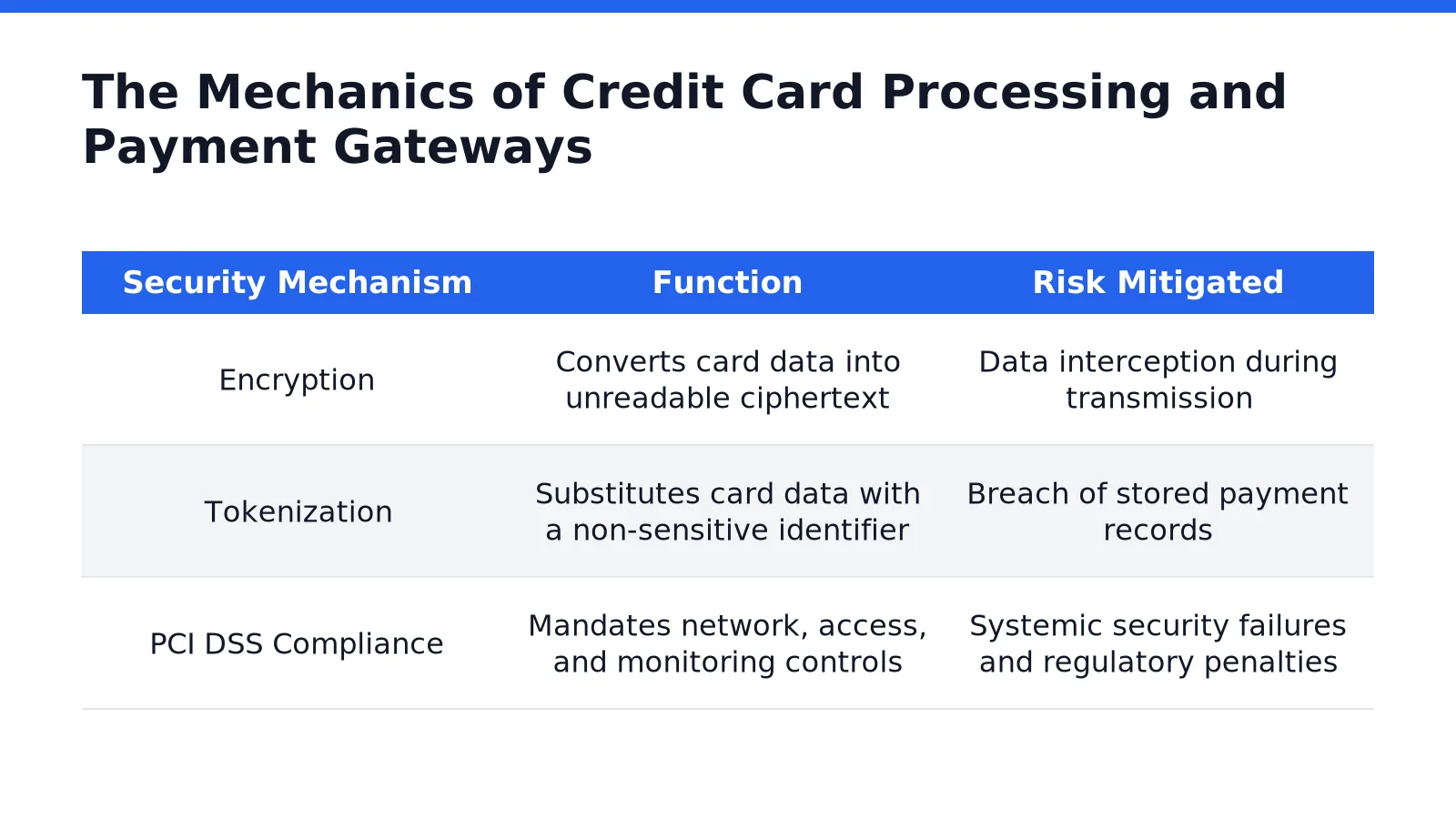
Three mandatory security layers protect payment data as it moves through the processing chain. Encryption protects payment data by converting it into a secure format that cannot be read without authorization. The moment a card number is entered, the gateway applies encryption algorithms that render the data useless to any interceptor. Tokenization replaces sensitive card data with a unique identifier to reduce fraud risk during transactions. The token holds no intrinsic value; it references the real card data stored in a secure vault offsite. A stolen token yields nothing to an attacker.
PCI DSS compliance is a mandatory security standard for all businesses handling credit card data. The Payment Card Industry Data Security Standard mandates specific network architecture, access controls, and monitoring protocols. Noncompliance triggers fines, forensic audits, and in severe cases, the permanent revocation of card acceptance privileges. A processing partner that embeds these security functions into its gateway removes the burden of direct PCI DSS scope management from the merchant. The alternative, a self-built integration that exposes raw card data to the merchant environment, multiplies both liability and audit costs.
The following table summarizes the three security mechanisms and their functions:
A gateway that fails to deliver all three layers exposes the merchant to data breaches, regulatory action, and irreversible reputational damage. The processing chain is only as strong as its weakest link.

Decoding Interchange Fees and Processing Pricing Models
Interchange fees constitute the largest component of credit card processing costs for any business. Card networks set these non-negotiable rates, which flow to the card-issuing bank on every transaction. A J.P. Morgan guide confirms that card networks establish B2B Payment Processing: Level 2 & 3 Cuts Card Fees, making them an unavoidable baseline expense that no processor can eliminate.
These fees vary by card type, transaction method, and merchant category. A rewards card swiped in person carries a different rate than a corporate card keyed into an online form. Without understanding this structure, a business owner absorbs costs that silently erode margins on every sale.
How Do Interchange-Plus, Flat-Rate, and Tiered Pricing Compare?
Three dominant pricing models determine what a business pays above interchange. Each model distributes cost and transparency differently.
Interchange-plus pricing separates the interchange fee from the processor’s markup. The merchant pays the exact interchange rate plus a disclosed margin, typically a small percentage and a per-transaction fee. This structure offers full transparency. A business sees precisely what goes to the card network and what goes to the processor.
Flat-rate pricing charges a single percentage for all transactions regardless of card type. A swiped debit card and a keyed-in corporate rewards card incur the same rate. Simplicity defines this model. The trade-off is cost: low-risk transactions subsidize high-risk ones, often resulting in a higher blended rate than interchange-plus for businesses with predictable card mixes.
Tiered pricing groups transactions into qualified, mid-qualified, and non-qualified categories. A processor assigns each transaction to a tier based on criteria the merchant rarely controls, such as whether a card is rewards-enabled or how quickly a batch settles. Qualified rates appear low. Non-qualified rates spike dramatically. This opacity makes true cost comparison difficult.
What Determines the Interchange Fee on a Given Transaction?
Card networks publish interchange tables that factor in multiple variables. The card type carries weight: a standard consumer credit card incurs a lower fee than a premium rewards card. The transaction method matters equally. A card-present, EMV-authenticated transaction qualifies for lower interchange than a card-not-present transaction where fraud risk escalates. Merchant category codes also influence the rate, with certain industries facing higher interchange due to historical chargeback patterns.
Settlement speed introduces another variable. Transactions batched and settled within 24 hours often receive more favorable interchange than those delayed beyond that window. Each of these factors compounds, producing a precise fee for every transaction that runs through the network.
Why Does Tiered Pricing Often Cost More Than Advertised?
Tiered pricing obscures the relationship between a transaction’s actual interchange cost and what the processor charges. A processor advertises a low qualified rate, but the majority of transactions land in mid-qualified or non-qualified tiers. Rewards cards, corporate cards, and manually keyed transactions routinely fall into non-qualified categories. The surcharge applied at that tier bears no direct relationship to the underlying interchange fee. A merchant paying a non-qualified rate loses a portion of each transaction to the processor’s tier assignment alone.
Charge.com delivers low-cost merchant accounts with rates as low as 0.25% and zero setup fees. The company’s interchange-plus structure provides line-item visibility into every transaction cost. This transparency allows a business to audit processing expenses against published interchange tables, a capability that flat-rate and tiered models structurally prevent.
How to Choose the Right Merchant Processing Solution
Selecting a merchant accounts provider determines settlement speed, fee structures, and customer payment experience. A processor’s capabilities directly affect daily cash flow and operational efficiency. The wrong choice introduces delays and erodes margins through undisclosed costs.
Credit card processing involves a chain of intermediaries that authorize, settle, and fund transactions. Businesses lose revenue when this chain operates slowly or opaquely. A processor’s infrastructure dictates whether funds arrive within 24 hours or remain held for days. According to the J.P. Morgan Credit Card & Payment Processing Guide for Businesses, choosing a payment processor shapes how quickly a business gets paid, what it pays in fees, and how well it serves customers. These three factors form the core evaluation criteria for any merchant services decision.
What hardware and software integrations should a business evaluate?
Hardware compatibility and payment gateways integration rank among the most consequential technical decisions. A processor must support the physical terminals, mobile readers, and e-commerce plugins a business already uses or plans to deploy. Charge.com equips merchants with free EMV countertop terminals and free mobile card readers for iOS and Android.
Gateway integration determines whether online checkout flows connect seamlessly to the processor’s authorization network. A hosted payment gateway reduces PCI compliance scope by keeping cardholder data off the merchant’s server. An API-based gateway offers greater customization but demands development resources. The evaluation must weigh these trade-offs against internal technical capacity.
How do contract terms and fee structures affect long-term costs?
Interchange fees represent the non-negotiable wholesale cost that card networks charge on every transaction. Processors add their markup on top of these assessments. The pricing model, whether interchange-plus, tiered, or flat-rate, determines transparency and total cost. Interchange-plus pricing passes the wholesale rate directly to the merchant with a disclosed markup, making it the most auditable structure.
Contract terms create the second layer of cost exposure. Early termination fees, monthly minimums, and ancillary service charges accumulate silently. Charge.com offers zero cancellation fees and no long-term contracts, reducing the risk of hidden processor fees. This structure eliminates the financial penalty for switching providers if service levels decline. Businesses locked into multi-year agreements with liquidated damages clauses forfeit negotiating leverage and absorb rate increases without recourse.
What support infrastructure protects against payment disruptions?
Payment downtime translates directly to lost revenue. A processor’s support availability, technical escalation paths, and system redundancy determine recovery speed when transactions fail. Charge.com provides 24/7/365 US-based technical support, ensuring that terminal malfunctions or gateway errors receive immediate attention regardless of when they occur. Businesses without this coverage risk hours of dead terminals during peak sales periods.
The evaluation process must verify support channels, average response times, and escalation procedures before signing any agreement. A processor that routes inquiries through offshore call centers or ticket-only systems introduces latency that a business cannot afford during a payment outage.
Getting Started with Charge.com
Charge.com delivers a turnkey entry point for businesses seeking domestic US credit card processing without the friction of setup costs or long-term contracts. The company holds the #1 merchant account provider rating for six consecutive years, a track record that signals consistent performance rather than a single strong quarter. Businesses that delay onboarding lose processing efficiency and absorb unnecessary fees from less transparent providers.
What Does the Onboarding Process Involve?
Charge.com structures account setup around speed and clarity. The onboarding path includes zero setup fees and zero cancellation fees, which removes the financial risk typically associated with switching processors. A streamlined application process moves qualified merchants from submission to processing readiness without extended underwriting delays. The absence of long-term contracts means a business retains operational flexibility from day one.
What Equipment and Tools Are Included?
New merchant accounts receive hardware and software at no additional cost. The standard package includes:
- Free EMV countertop terminals for in-person transactions
- Free mobile card readers compatible with iOS and Android devices
- Free virtual terminals for phone and mail order payments
- Turnkey e-commerce payment gateways with preconfigured integration
These tools cover the four primary acceptance channels: online, in-person, mobile, and phone/mail. A business does not need to purchase separate solutions for each channel, which consolidates vendor management and reduces total cost of ownership.
How Does Charge.com Handle Specialized Processing Needs?
Businesses classified as high-risk or processing high volumes face rejection from many standard providers. Charge.com maintains dedicated underwriting for high-risk and high-volume merchant categories. This capability matters for industries such as subscription services, travel, nutraceuticals, and other verticals where traditional acquirers decline applications. Without this underwriting path, such businesses lose access to card acceptance entirely or pay inflated interchange fees through workaround solutions.
What Support Structure Backs the Account?
Charge.com provides 24/7/365 US-based technical support. Support availability spans every day of the year, including holidays, which prevents downtime from becoming unrecoverable revenue loss. The support team operates domestically, reducing the communication barriers that plague offshore call centers.
The combination of zero setup fees, free hardware, and no long-term contracts positions Charge.com as a low-commitment entry point for merchants evaluating processing partners. A business can test the platform without locking into multi-year obligations or absorbing upfront capital costs.
FAQ
What is a merchant account and how does it work?
A merchant account is a specialized bank account that temporarily holds card transaction funds before settlement to a business’s primary bank account, typically settling within one to two business days.
How do merchant accounts differ from payment aggregators?
A dedicated merchant account provides a direct processing relationship with an acquiring bank, with the business undergoing individual risk assessment and receiving its own merchant identification number, while payment aggregators pool multiple businesses under a shared master account.
What rates and fees does Charge.com offer for merchant accounts?
Charge.com provides rates as low as 0.25%, zero setup fees, zero cancellation fees, and no long-term contracts for domestic US merchant credit card processing services.
Conclusion
Selecting a merchant account provider requires evaluating contract terms, pricing transparency, hardware costs, and support infrastructure against a business’s specific transaction profile. A provider that eliminates long-term commitments, setup fees, and cancellation penalties reduces financial risk while maintaining operational flexibility. Businesses that prioritize interchange-plus pricing, free equipment, and 24/7 US-based support position themselves to minimize processing costs and avoid service disruptions. The evaluation process should verify these factors before signing any agreement.